
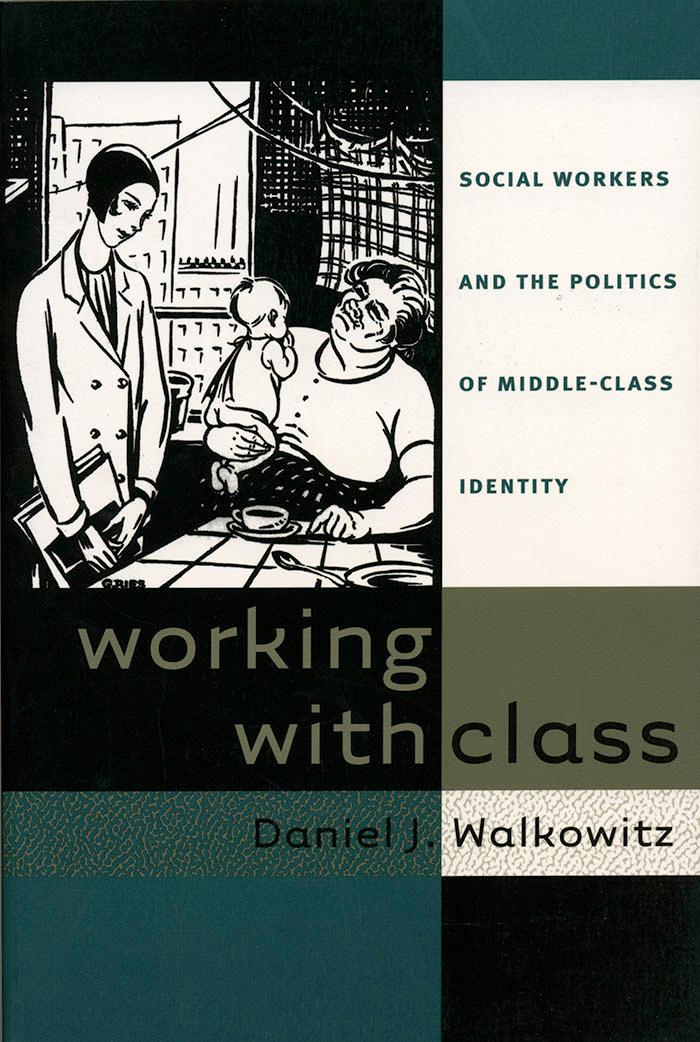
Polls tell us that most Americans — whether they earn $20,000 or $200,000 a year — think of themselves as middle class. As this phenomenon suggests, “middle class” is a category whose definition is not necessarily self-evident. In this book, historian Daniel Walkowitz approaches the question of what it means to be middle class from an innovative angle. Focusing on the history of social workers — who daily patrol the boundaries of class — he examines the changed and contested meaning of the term over the last one hundred years.
Walkowitz uses the study of social workers to explore the interplay of race, ethnicity, and gender with class. He examines the trade union movement within the mostly female field of social work and looks at how a paradigmatic conflict between blacks and Jews in New York City during the 1960s shaped late-twentieth-century social policy concerning work, opportunity, and entitlements. In all, this is a story about the ways race and gender divisions in American society have underlain the confusion about the identity and role of the middle class.
Pay easily by card, Klarna, Apple Pay or Google Pay. Not happy? You always have a 14-day money-back guarantee. Read more in our terms. If you have any questions, email us at hello@memmo.org.
Memmo makes studying easier – wherever you are in the world. We bring your course books and smart study tools together in one place: summaries, quizzes, podcasts and flashcards. Plus Ted, your study buddy who answers anything you wonder. Over 50,000 students already study here – built to help you learn faster and stress less.