
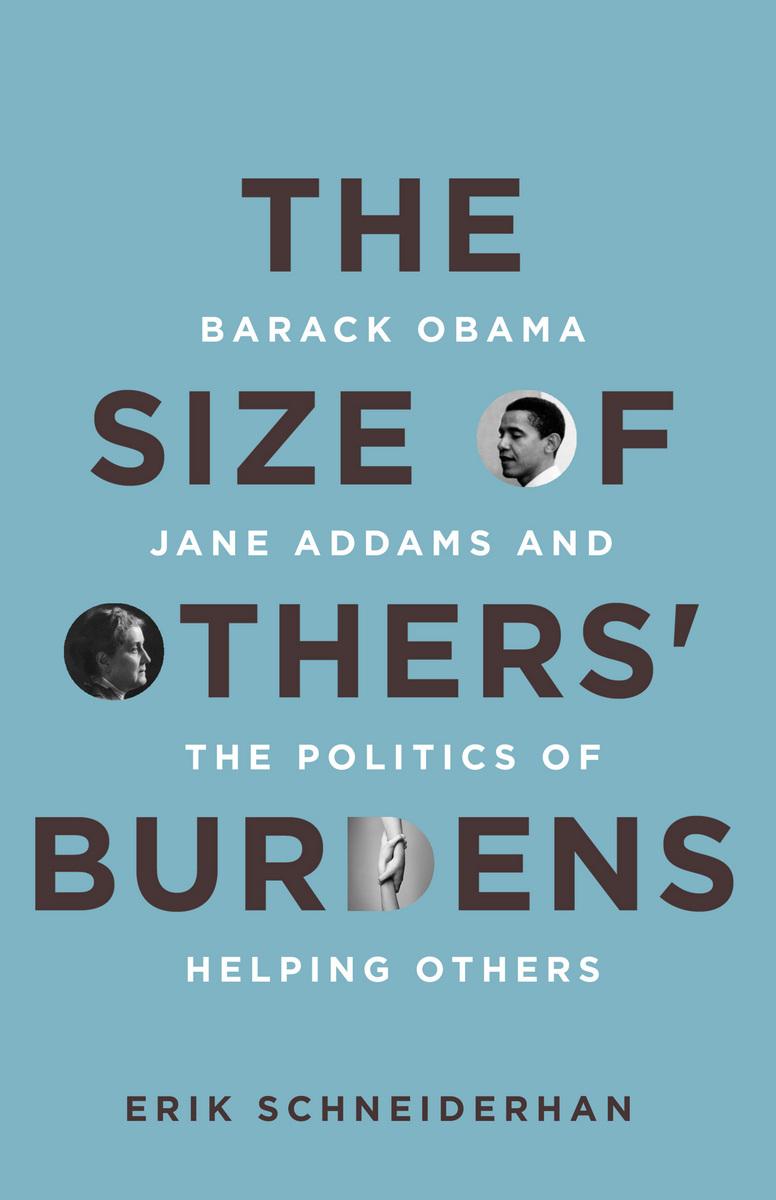
Americans have a fierce spirit of individualism. We pride ourselves on self-reliance, on bootstrapping our way to success. Yet, we also believe in helping those in need, and we turn to our neighbors in times of crisis. The tension between these competing values is evident, and how we balance between these competing values holds real consequences for community health and well-being. In his new book, The Size of Others' Burdens, Erik Schneiderhan asks how people can act in the face of competing pressures, and explores the stories of two famous Americans to develop present-day lessons for improving our communities.
Although Jane Addams and Barack Obama are separated by roughly one hundred years, the parallels between their lives are remarkable: Chicago activists-turned-politicians, University of Chicago lecturers, gifted orators, crusaders against discrimination, winners of the Nobel Peace Prize. Addams was the founder of Hull-House, the celebrated American "settlement house" that became the foundation of modern social work. Obama's remarkable rise to the presidency is well known.
Through the stories of Addams's and Obama's early community work, Erik Schneiderhan challenges readers to think about how many of our own struggles are not simply personal challenges, but also social challenges. How do we help others when so much of our day-to-day life is geared toward looking out for ourselves, whether at work or at home? Not everyone can run for president or win a Nobel Prize, but we can help others without sacrificing their dignity or our principles. Great thinkers of the past and present can give us the motivation; Addams and Obama show us how. Schneiderhan highlights the value of combining today's state resources with the innovation and flexibility of Addams's time to encourage community building. Offering a call to action, this book inspires readers to address their own American dilemma and connect to community, starting within our own neighborhoods.
Pay easily by card, Klarna, Apple Pay or Google Pay. Not happy? You always have a 14-day money-back guarantee. Read more in our terms. If you have any questions, email us at hello@memmo.org.
Memmo makes studying easier – wherever you are in the world. We bring your course books and smart study tools together in one place: summaries, quizzes, podcasts and flashcards. Plus Ted, your study buddy who answers anything you wonder. Over 50,000 students already study here – built to help you learn faster and stress less.