
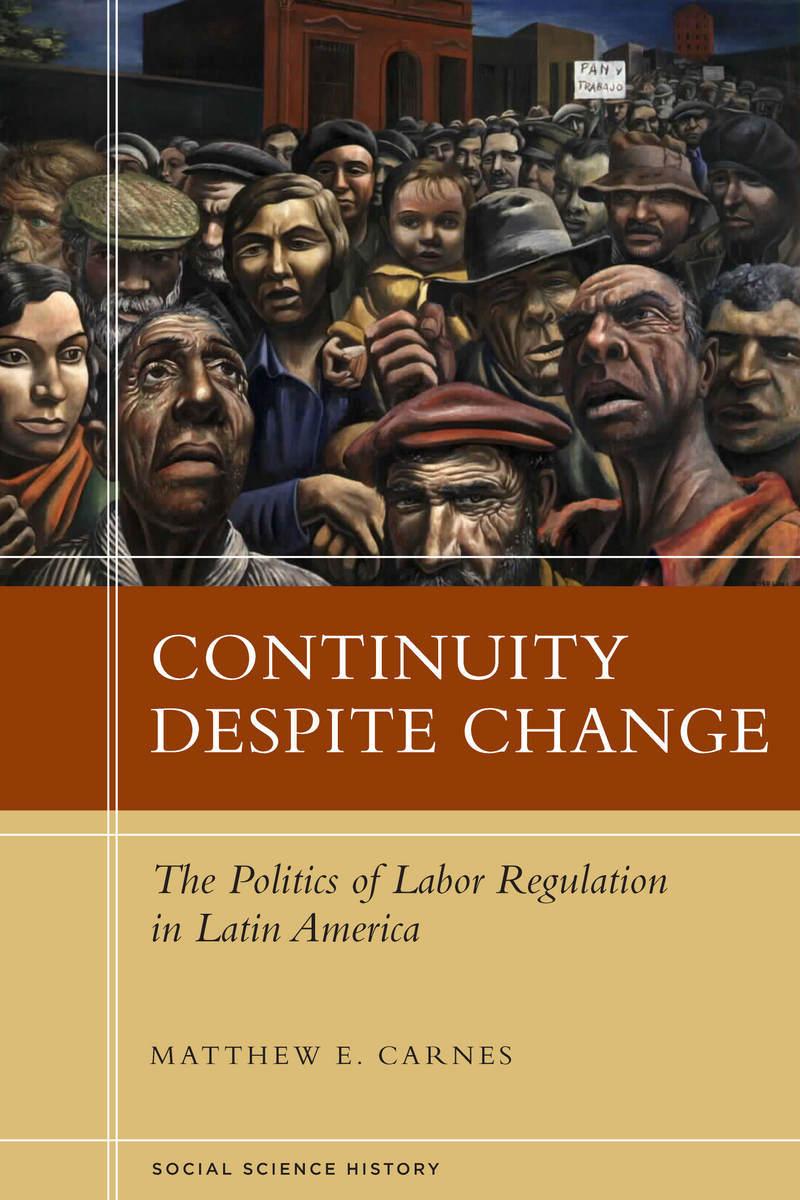
As the dust settles on nearly three decades of economic reform in Latin America, one of the most fundamental economic policy areas has changed far less than expected: labor regulation. To date, Latin America's labor laws remain both rigidly protective and remarkably diverse. Continuity Despite Change develops a new theoretical framework for understanding labor laws and their change through time, beginning by conceptualizing labor laws as comprehensive systems or "regimes." In this context, Matthew Carnes demonstrates that the reform measures introduced in the 1980s and 1990s have only marginally modified the labor laws from decades earlier. To explain this continuity, he argues that labor law development is constrained by long-term economic conditions and labor market institutions. He points specifically to two key factors—the distribution of worker skill levels and the organizational capacity of workers.
Carnes presents cross-national statistical evidence from the eighteen major Latin American economies to show that the theory holds for the decades from the 1980s to the 2000s, a period in which many countries grappled with proposed changes to their labor laws. He then offers theoretically grounded narratives to explain the different labor law configurations and reform paths of Chile, Peru, and Argentina. His findings push for a rethinking of the impact of globalization on labor regulation, as economic and political institutions governing labor have proven to be more resilient than earlier studies have suggested.
Pay easily by card, Klarna, Apple Pay or Google Pay. Not happy? You always have a 14-day money-back guarantee. Read more in our terms. If you have any questions, email us at hello@memmo.org.
Memmo makes studying easier – wherever you are in the world. We bring your course books and smart study tools together in one place: summaries, quizzes, podcasts and flashcards. Plus Ted, your study buddy who answers anything you wonder. Over 50,000 students already study here – built to help you learn faster and stress less.