
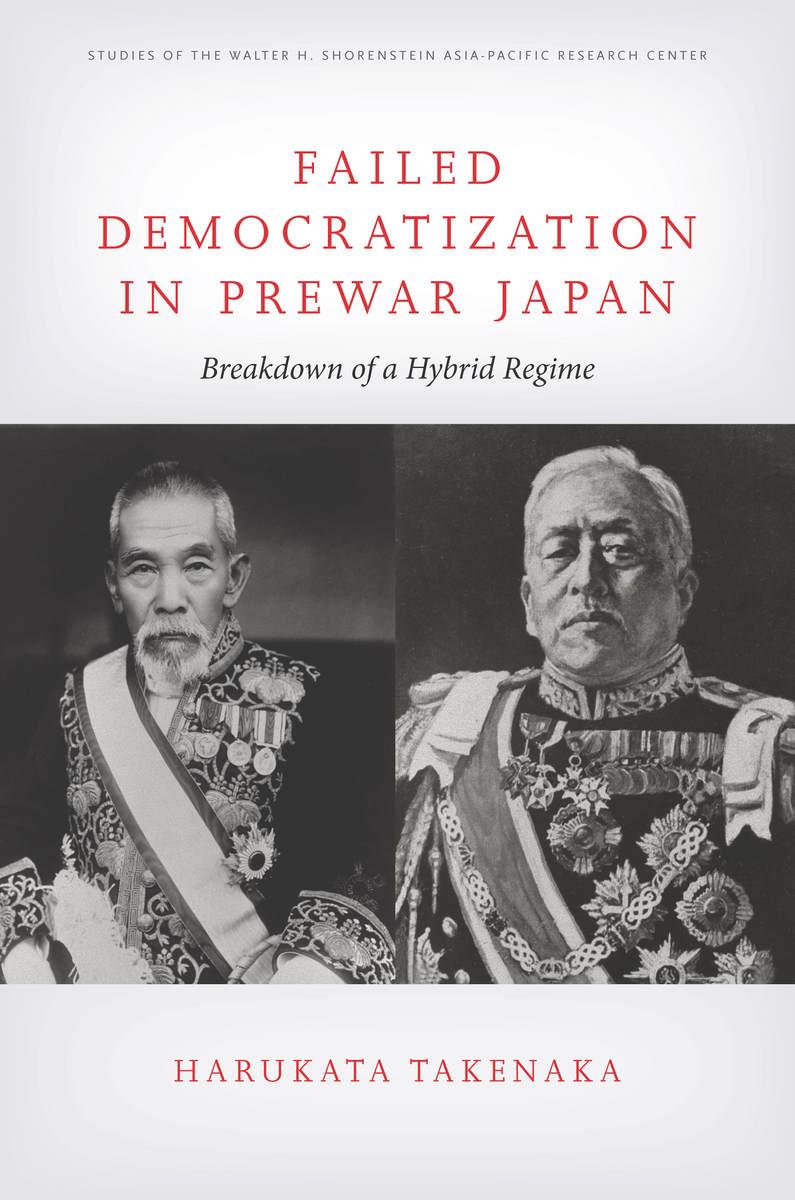
Failed Democratization in Prewar Japan presents a compelling case study on change in political regimes through its exploration of Japan's transition to democracy. Within a broad-ranging examination of Japan's "semi-democratic" political system from 1918 to 1932, when political parties tended to dominate the government, the book analyzes in detail why this system collapsed in 1932 and discusses the implications of the failure.
By reference to comparable cases—prewar Argentina, prewar Germany, postwar Brazil, and 1980s Thailand—Harukata Takenaka reveals that the factors responsible for the breakdown of the Taisho democracy in Japan replicated those that precipitated the collapse of democracy in Europe, Latin America, and elsewhere in Asia.
While most literature on these transitions focuses on successful cases, Takenaka explores democratic failure to answer questions about how and why political parties and their leaders can behave in ways that undermine the democratic institutions that serve as the basis for their formal authority.
Pay easily by card, Klarna, Apple Pay or Google Pay. Not happy? You always have a 14-day money-back guarantee. Read more in our terms. If you have any questions, email us at hello@memmo.org.
Memmo makes studying easier – wherever you are in the world. We bring your course books and smart study tools together in one place: summaries, quizzes, podcasts and flashcards. Plus Ted, your study buddy who answers anything you wonder. Over 50,000 students already study here – built to help you learn faster and stress less.