
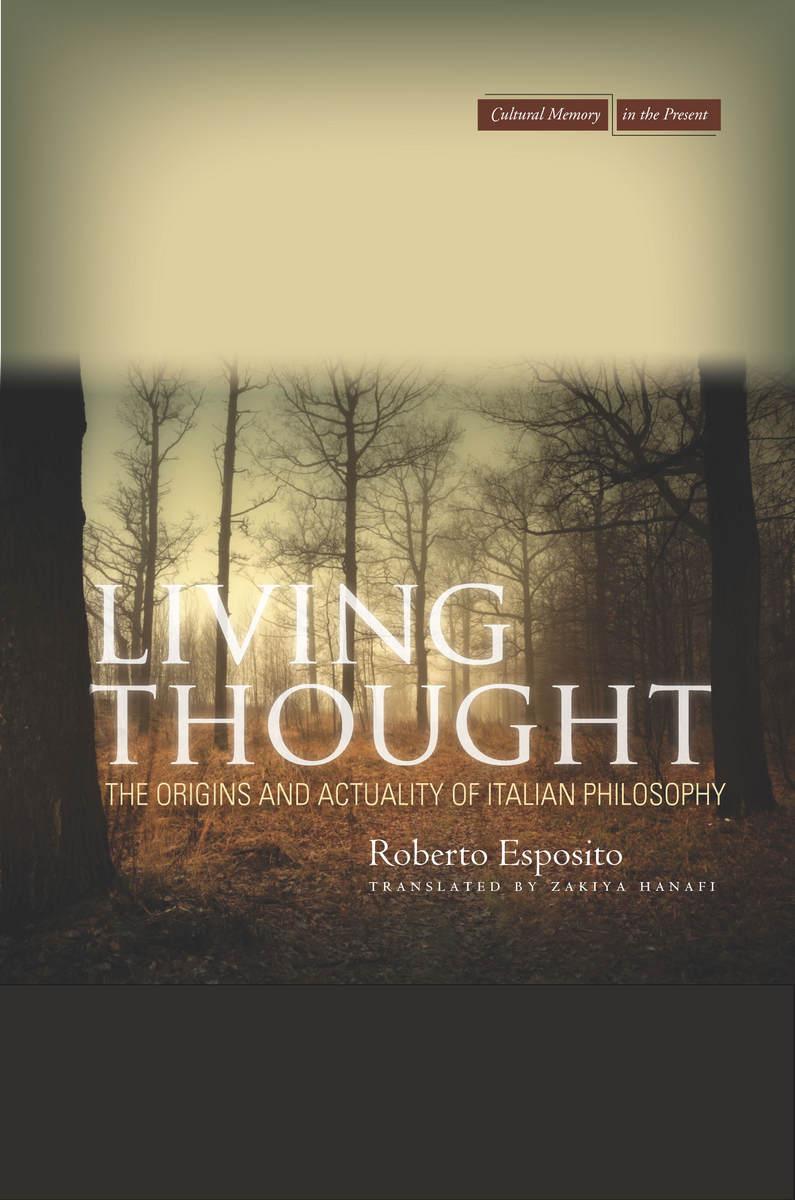
The work of contemporary Italian thinkers, what Roberto Esposito refers to as Italian Theory, is attracting increasing attention around the world. This book explores the reasons for its growing popularity, its distinguishing traits, and why people are turning to these authors for answers to real-world issues and problems. The approach he takes, in line with the keen historical consciousness of Italian thinkers themselves, is a historical one. He offers insights into the great "unphilosophical" philosophers of life—poets, painters, politicians and revolutionaries, film-makers and literary critics—who have made Italian thought, from its beginnings, an "impure" thought. People like Machiavelli, Croce, Gentile, and Gramsci were all compelled to fulfill important political roles in the societies of their times. No wonder they felt that the abstract vocabulary and concepts of pure philosophy were inadequate to express themselves. Similarly, artists such as Dante, Leonardo Da Vinci, Leopardi, or Pasolini all had to turn to other disciplines outside philosophy in order to discuss and grapple with the messy, constantly changing realities of their lives.
For this very reason, says Esposito, because Italian thinkers have always been deeply engaged with the concrete reality of life (rather than closed up in the introspective pursuits of traditional continental philosophy) and because they have looked for the answers of today in the origins of their own historical roots, Italian theory is a "living thought." Hence the relevance or actuality that it holds for us today.
Continuing in this tradition, the work of Roberto Esposito is distinguished by its interdisciplinary breadth. In this book, he passes effortlessly from literary criticism to art history, through political history and philosophy, in an expository style that welcomes non-philosophers to engage in the most pressing problems of our times. As in all his works, Esposito is inclusive rather than exclusive; in being so, he celebrates the affirmative potency of life.
Pay easily by card, Klarna, Apple Pay or Google Pay. Not happy? You always have a 14-day money-back guarantee. Read more in our terms. If you have any questions, email us at hello@memmo.org.
Memmo makes studying easier – wherever you are in the world. We bring your course books and smart study tools together in one place: summaries, quizzes, podcasts and flashcards. Plus Ted, your study buddy who answers anything you wonder. Over 50,000 students already study here – built to help you learn faster and stress less.