
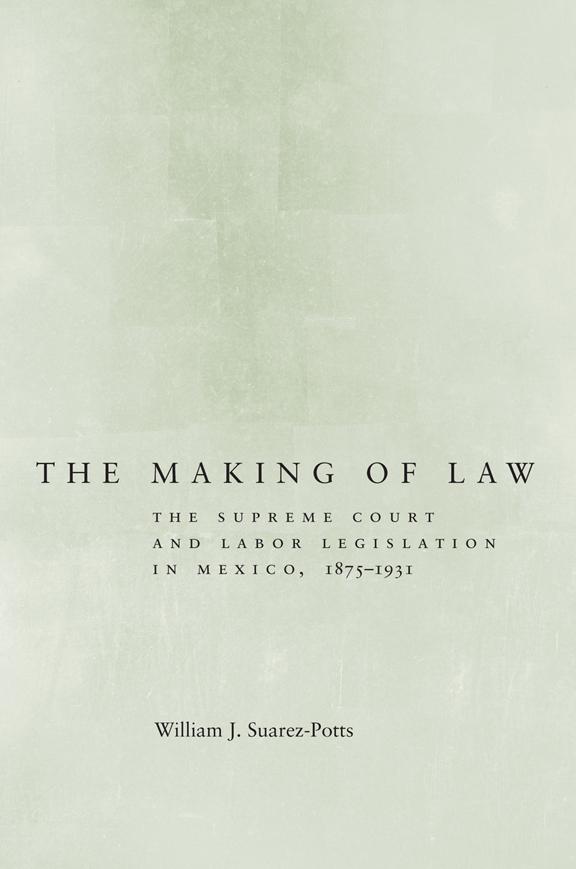
Despite Porfirio Díaz's authoritarian rule (1877-1911) and the fifteen years of violent conflict typifying much of Mexican politics after 1917, law and judicial decision-making were important for the country's political and economic organization. Influenced by French theories of jurisprudence in addition to domestic events, progressive Mexican legal thinkers concluded that the liberal view of law—as existing primarily to guarantee the rights of individuals and of private property—was inadequate for solving the "social question"; the aim of the legal regime should instead be one of harmoniously regulating relations between interdependent groups of social actors. This book argues that the federal judiciary's adjudication of labor disputes and its elaboration of new legal principles played a significant part in the evolution of Mexican labor law and the nation's political and social compact. Indeed, this conclusion might seem paradoxical in a country with a civil law tradition, weak judiciary, authoritarian government, and endemic corruption. Suarez-Potts shows how and why judge-made law mattered, and why contemporaries paid close attention to the rulings of Supreme Court justices in labor cases as the nation's system of industrial relations was established.
Pay easily by card, Klarna, Apple Pay or Google Pay. Not happy? You always have a 14-day money-back guarantee. Read more in our terms. If you have any questions, email us at hello@memmo.org.
Memmo makes studying easier – wherever you are in the world. We bring your course books and smart study tools together in one place: summaries, quizzes, podcasts and flashcards. Plus Ted, your study buddy who answers anything you wonder. Over 50,000 students already study here – built to help you learn faster and stress less.