
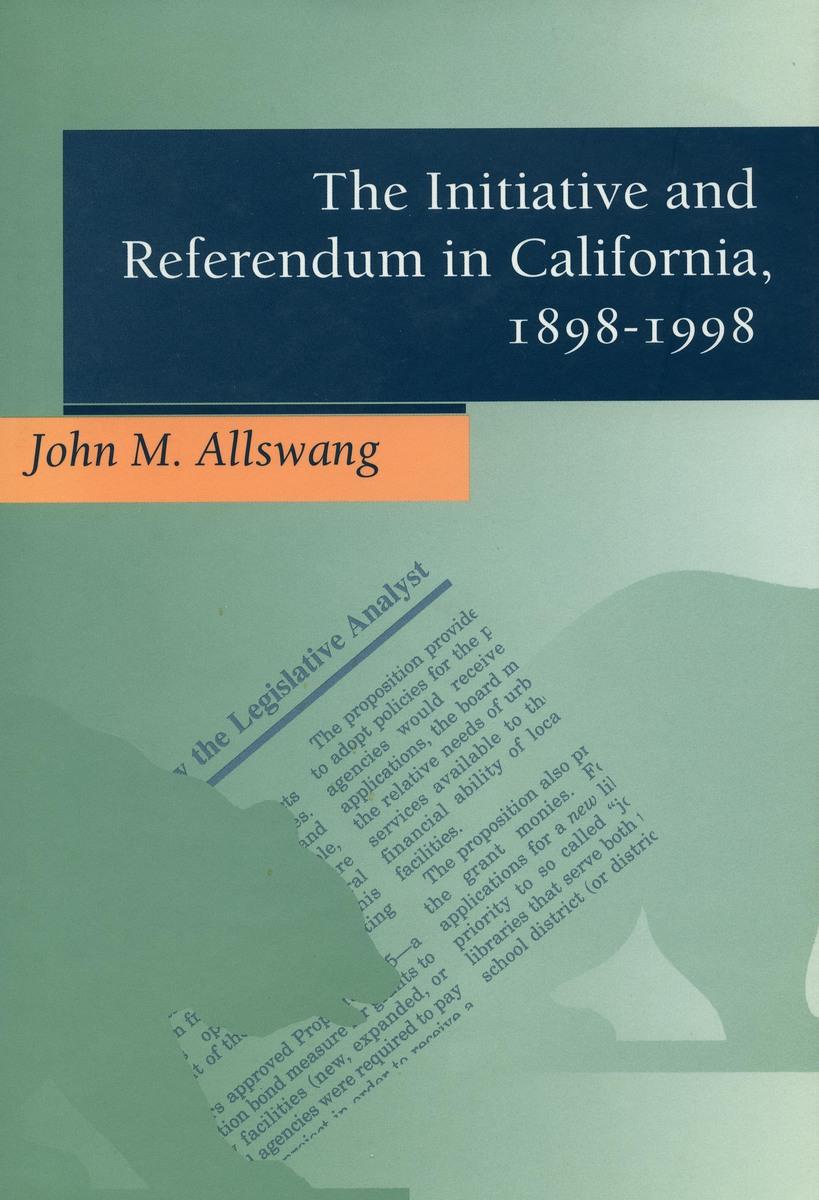
This book provides a detailed analytic history of direct legislation—the initiative and referendum—in California from its origins in the late nineteenth century to the present day. California was one of the first states to implement mechanisms for direct legislation, and these mechanisms have been used with growing frequency as the entire process has become professionalized (from signature-gathering through fund-raising to legal challenge and defense). The author studies this important political device in terms of voter interest and behavior, its role in public issues, and how it has affected the state’s politics and government.
The book first analyzes how and why direct legislation came to California, seeing it as a typical example of the disconnected nature of progressive era reforms. It then studies selectively, from among the 300 propositions that have been on California ballots, those propositions that have been most relevant to the major issues of their time, have generated the highest levels of voter interest and participation, and have shaped the development of state politics and government.
The author pays particular attention to the explosion of direct legislation, in frequency and consequence, since the Proposition 13 “property tax revolution” of 1978. He also describes how California’s contemporary direct legislation experience—from tax rebellion to harsher criminal justice to controversial ethnic issues—has had national ramifications. The book concludes with a careful analysis of the current state of the initiative and referendum in California: voter attitudes toward the process, its role as a “fourth branch” of government, and arguments for and against changes in the procedure.
Based on extensive research in campaign documents, manuscript collections, the contemporary press, and other primary sources, the book also makes extensive use of voting data, public opinion polls, and official filings of campaign expenditures. All in all, it is the most comprehensive study ever made of a political process that is used today in twenty-seven states.
Pay easily by card, Klarna, Apple Pay or Google Pay. Not happy? You always have a 14-day money-back guarantee. Read more in our terms. If you have any questions, email us at hello@memmo.org.
Memmo makes studying easier – wherever you are in the world. We bring your course books and smart study tools together in one place: summaries, quizzes, podcasts and flashcards. Plus Ted, your study buddy who answers anything you wonder. Over 50,000 students already study here – built to help you learn faster and stress less.