
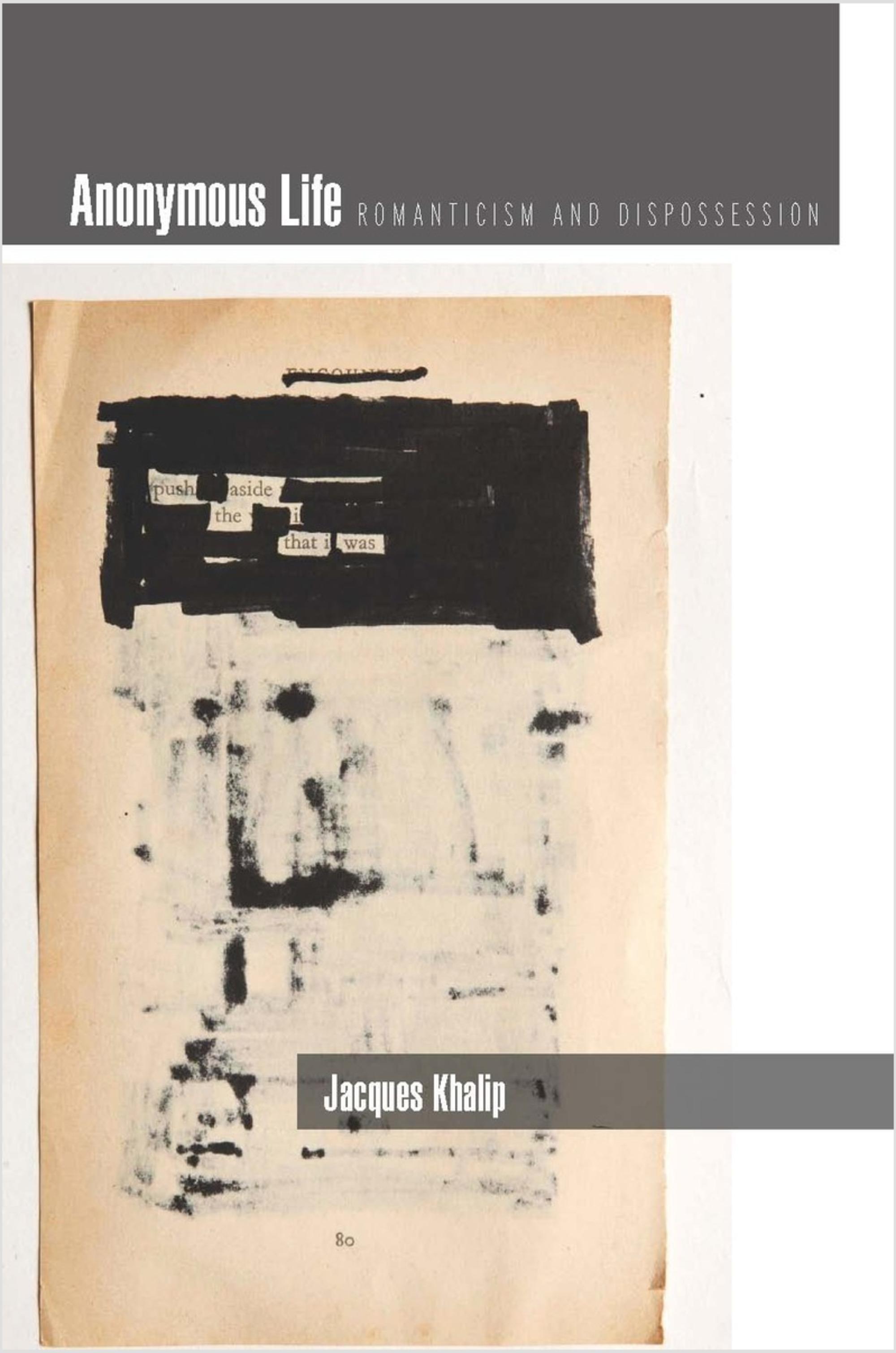
Romanticism is often synonymous with models of identity and action that privilege individual empowerment and emotional autonomy. In the last two decades, these models have been the focus of critiques of Romanticism's purported self-absorption and alienation from politics. While such critiques have proven useful, they often draw attention to the conceptual or material tensions of romantic subjectivity while accepting a conspicuous, autonomous subject as a given, thus failing to appreciate the possibility that Romanticism sustains an alternative model of being, one anonymous and dispossessed, one whose authority is irreducible to that of an easily recognizable, psychologized persona. In Anonymous Life, Khalip goes against the grain of these dominant critical stances by examining anonymity as a model of being that is provocative for writers of the era because it resists the Enlightenment emphasis on transparency and self-disclosure. He explores how romantic subjectivity, even as it negotiates with others in the social sphere, frequently rejects the demands of self-assertion and fails to prove its authenticity and coherence.
Pay easily by card, Klarna, Apple Pay or Google Pay. Not happy? You always have a 14-day money-back guarantee. Read more in our terms. If you have any questions, email us at hello@memmo.org.
Memmo makes studying easier – wherever you are in the world. We bring your course books and smart study tools together in one place: summaries, quizzes, podcasts and flashcards. Plus Ted, your study buddy who answers anything you wonder. Over 50,000 students already study here – built to help you learn faster and stress less.