
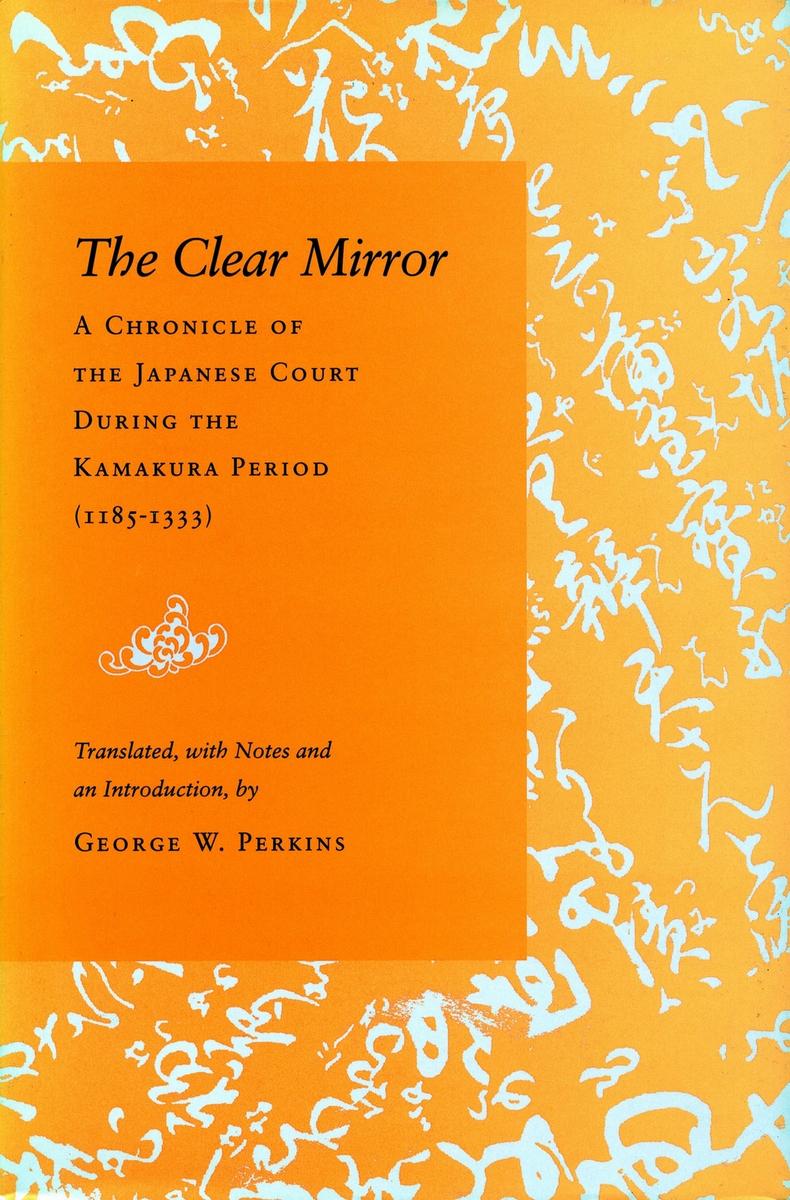
The Clear Mirror (Masukagami) is an account of Japanese history from 1185 to 1333 by an anonymous author, almost certainly a court noble writing around the third quarter of the fourteenth century. During this time, the military government at Kamakura controlled the country, maintaining the emperor with his court at Kyoto as symbolic head of state. Though the imperial court had little real power, it attempted to maintain as much of its former dignity and prestige as it could.
The Clear Mirror is at least semi-fictionalized, promoting a picture of a court healthier and more powerful than it really was. Moreover, the work sees the court as guardian of its own traditional arts and lifestyle, and thus provides not only a history of imperial succession and other events but also copious examples of poetic expressions and descriptions of courtly traditions and ceremonies. Because of its attempt to exemplify the best in the courtly prose tradition (it is noted for its imitation of the style of the masterpiece The Tale of Genji), the work has long been valued in Japan as much for its artistic literary contribution as for its historical significance. The present translation makes available to English readers the last significant work belonging to the genre of "historical tales" (rekishi monogatari), another example of which is A Tale of Flowering Fortunes (translated by William and Helen Craig McCullough, Stanford, 1980).
The introduction provides a brief summary of the significant historical and political events of the period, together with a discussion of the significance of The Clear Mirror within the "historical tales" tradition, and comments on the literary strengths and weaknesses of the work. A glossary identifies people and places mentioned in the text, and an appendix discusses details concerning the work's authorship, possible dates of initial publication, and other matters relating to the original manuscript.
Pay easily by card, Klarna, Apple Pay or Google Pay. Not happy? You always have a 14-day money-back guarantee. Read more in our terms. If you have any questions, email us at hello@memmo.org.
Memmo makes studying easier – wherever you are in the world. We bring your course books and smart study tools together in one place: summaries, quizzes, podcasts and flashcards. Plus Ted, your study buddy who answers anything you wonder. Over 50,000 students already study here – built to help you learn faster and stress less.