
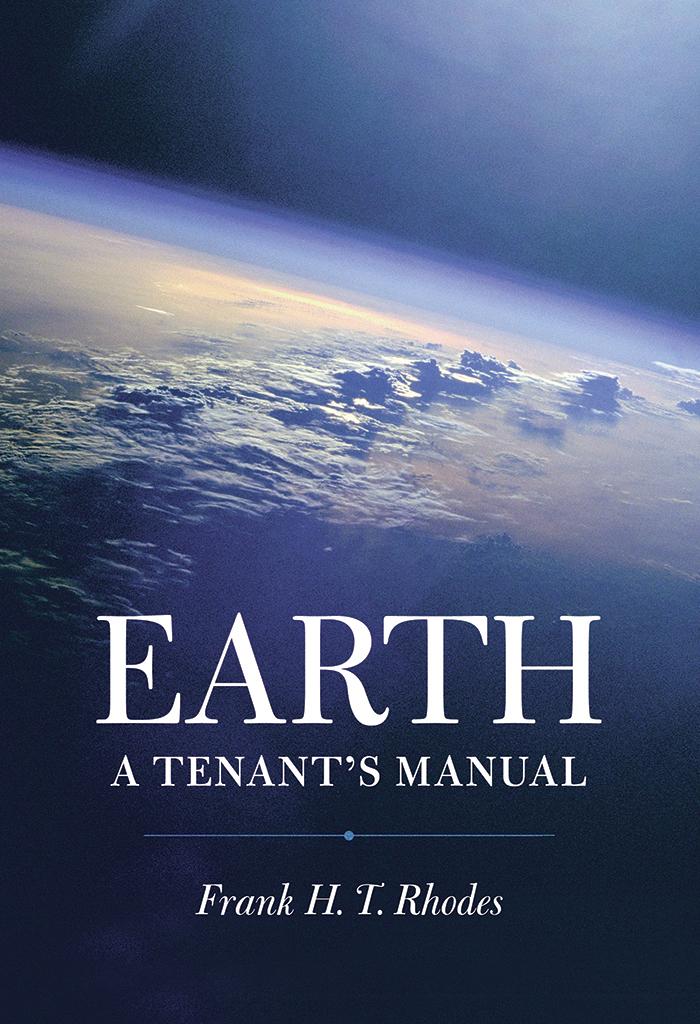
"It's impossible to grasp the whole planet or integrate all the descriptions of it. But because we live here, we have to try. This is not just an artistic compulsion or an existential yearning, still less an academic exercise. It's a survival issue. This is the only planet we have. We're stuck here, and we don't own the place—it would be the height of arrogance to assume that we do. We're tenants here, not owners, but we're tenants with hope for a long-term tenancy. We want to extend our lease just as far as we can."—from Earth: A Tenant's Manual
In Earth: A Tenant's Manual, the distinguished geologist Frank H. T. Rhodes, President Emeritus of Cornell University, provides a sweeping, accessible, and deeply informed guide to the home we all share, showing us how we might best preserve the Earth's livability for ourselves and future generations.
Rhodes begins by setting the scene for our active planet and explaining how its location and composition determine how the Earth works and why it teems with life. He emphasizes the changes that are of concern to us today, from earthquakes to climate change and the clashes over the energy resources needed for the Earth's exploding population. He concludes with an extended exploration of humanity's prospects on a complex, protean, and ultimately finite world.
It is not a question of whether the planet is sustainable; the challenge facing life on Earth—and the life of the Earth—is whether an expanding and high-consumption species like ours is sustainable. Only new resources, new priorities, new policies and, most of all, new knowledge, can reverse the damage that humanity is doing to our home—and ourselves. A sustainable human future, Rhodes concludes in this eloquent, sobering, but ultimately optimistic book, will require a sense of responsible stewardship, for we are not owners of this planet; we are tenants.
Surveying the systems, large and small, that govern Earth's processes and influence its changes, Rhodes addresses the negative consequences of human activities for the health of its regulatory systems but offers practical suggestions as to how we might effect repairs, or at least limit further damage to our home.
Pay easily by card, Klarna, Apple Pay or Google Pay. Not happy? You always have a 14-day money-back guarantee. Read more in our terms. If you have any questions, email us at hello@memmo.org.
Memmo makes studying easier – wherever you are in the world. We bring your course books and smart study tools together in one place: summaries, quizzes, podcasts and flashcards. Plus Ted, your study buddy who answers anything you wonder. Over 50,000 students already study here – built to help you learn faster and stress less.