
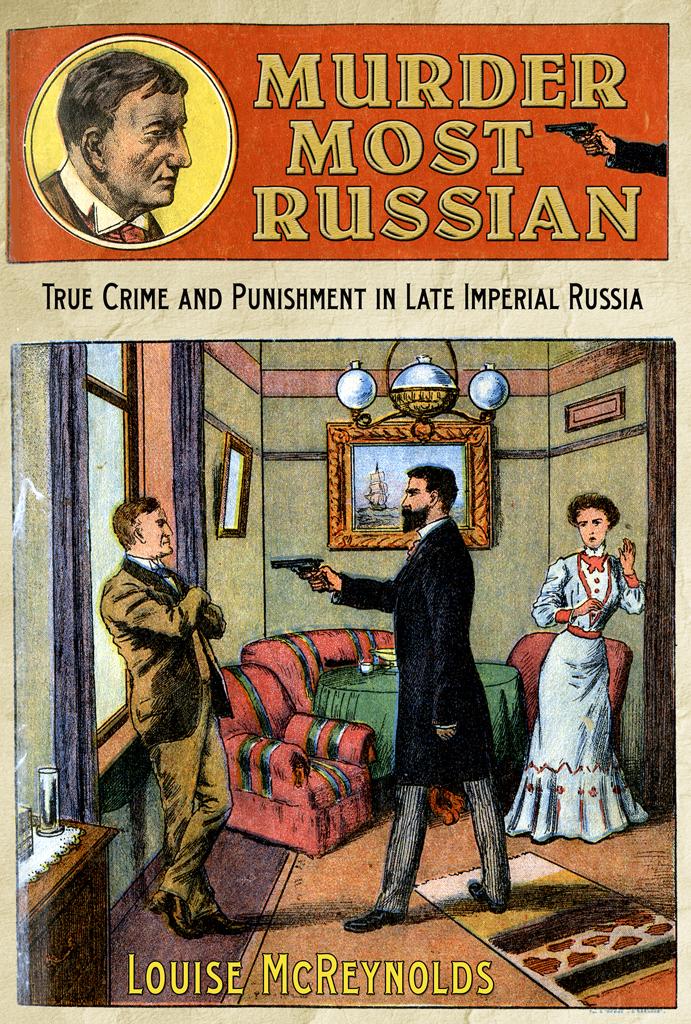
How a society defines crimes and prosecutes criminals illuminates its cultural values, social norms, and political expectations. In Murder Most Russian, Louise McReynolds draws on a fascinating series of murders and subsequent trials that took place in the wake of the 1864 legal reforms enacted by Tsar Alexander II. For the first time in Russian history, the accused were placed in the hands of juries of common citizens in courtrooms that were open to the press. Drawing on a wide array of sources, McReynolds reconstructs murders that gripped Russian society, from the case of Andrei Gilevich, who advertised for a personal secretary and beheaded the respondent as a way of perpetrating insurance fraud, to the beating death of Marianna Time at the hands of two young aristocrats who hoped to steal her diamond earrings.
As McReynolds shows, newspapers covered such trials extensively, transforming the courtroom into the most public site in Russia for deliberation about legality and justice. To understand the cultural and social consequences of murder in late imperial Russia, she analyzes the discussions that arose among the emergent professional criminologists, defense attorneys, and expert forensic witnesses about what made a defendant's behavior "criminal." She also deftly connects real criminal trials to the burgeoning literary genre of crime fiction and fruitfully compares the Russian case to examples of crimes both from Western Europe and the United States in this period. Murder Most Russian will appeal not only to readers interested in Russian culture and true crime but also to historians who study criminology, urbanization, the role of the social sciences in forging the modern state, evolving notions of the self and the psyche, the instability of gender norms, and sensationalism in the modern media.
Pay easily by card, Klarna, Apple Pay or Google Pay. Not happy? You always have a 14-day money-back guarantee. Read more in our terms. If you have any questions, email us at hello@memmo.org.
Memmo makes studying easier – wherever you are in the world. We bring your course books and smart study tools together in one place: summaries, quizzes, podcasts and flashcards. Plus Ted, your study buddy who answers anything you wonder. Over 50,000 students already study here – built to help you learn faster and stress less.