
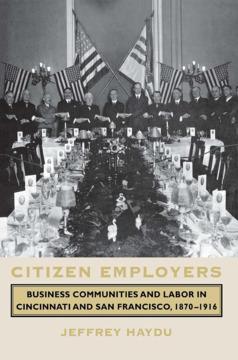
The exceptional weakness of the American labor movement has often been attributed to the successful resistance of American employers to unionization and collective bargaining. However, the ideology deployed against labor's efforts to organize at the grassroots level has received less attention. In Citizen Employers, Jeffrey Haydu compares the very different employer attitudes and experiences that guided labor-capital relations in two American cities, Cincinnati and San Francisco, in the period between the Civil War and World War I. His account puts these attitudes and experiences into the larger framework of capitalist class formation and businessmen's collective identities.
Cincinnati and San Francisco saw dramatically different developments in businessmen's class alignments, civic identities, and approach to unions. In Cincinnati, manufacturing and commercial interests joined together in a variety of civic organizations and business clubs. These organizations helped members overcome their conflicts and identify their interests with the good of the municipal community. That pervasive ideology of "business citizenship" provided much of the rationale for opposing unions. In sharp contrast, San Francisco's businessmen remained divided among themselves, opted to side with white labor against the Chinese, and advocated treating both unions and business organizations as legitimate units of economic and municipal governance.
Citizen Employers closely examines the reasons why these two bourgeoisies, located in comparable cities in the same country at the same time, differed so radically in their degree of unity and in their attitudes toward labor unions, and how their views would ultimately converge and harden against labor by the 1920s. With its nuanced depiction of civic ideology and class formation and its application of social movement theory to economic elites, this book offers a new way to look at employer attitudes toward unions and collective bargaining. That new approach, Haydu argues, is equally applicable to understanding challenges facing the American labor movement today.
Pay easily by card, Klarna, Apple Pay or Google Pay. Not happy? You always have a 14-day money-back guarantee. Read more in our terms. If you have any questions, email us at hello@memmo.org.
Memmo makes studying easier – wherever you are in the world. We bring your course books and smart study tools together in one place: summaries, quizzes, podcasts and flashcards. Plus Ted, your study buddy who answers anything you wonder. Over 50,000 students already study here – built to help you learn faster and stress less.