
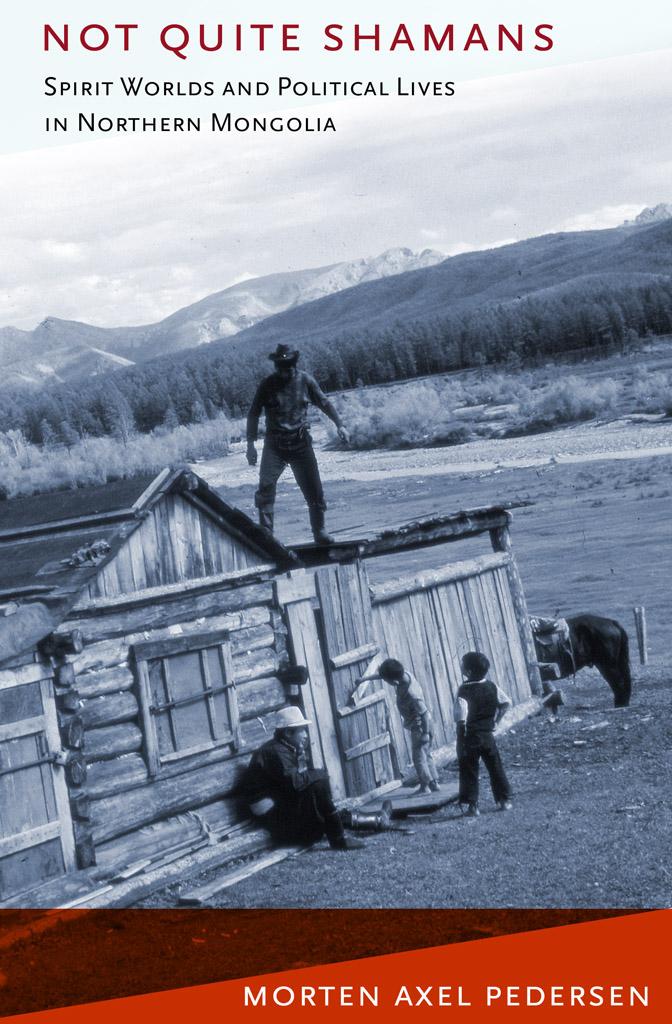
The forms of contemporary society and politics are often understood to be diametrically opposed to any expression of the supernatural; what happens when those forms are themselves regarded as manifestations of spirits and other occult phenomena? In Not Quite Shamans, Morten Axel Pedersen explores how the Darhad people of Northern Mongolia's remote Shishged Valley have understood and responded to the disruptive transition to postsocialism by engaging with shamanic beliefs and practices associated with the past.
For much of the twentieth century, Mongolia's communist rulers attempted to eradicate shamanism and the shamans who once served as spiritual guides and community leaders. With the transition from a collectivized economy and a one-party state to a global capitalist market and liberal democracy in the 1990s, the people of the Shishged were plunged into a new and harsh world that seemed beyond their control. "Not-quite-shamans"—young, unemployed men whose undirected energies erupted in unpredictable, frightening bouts of violence and drunkenness that seemed occult in their excess— became a serious threat to the fabric of community life. Drawing on long-term fieldwork in Northern Mongolia, Pedersen details how, for many Darhads, the postsocialist state itself has become shamanic in nature.
In the ideal version of traditional Darhad shamanism, shamans can control when and for what purpose their souls travel, whether to other bodies, landscapes, or worlds. Conversely, caught between uncontrollable spiritual powers and an excessive display of physical force, the "not-quite-shamans" embody the chaotic forms—the free market, neoliberal reform, and government corruption—that have created such upheaval in peoples' lives. As an experimental ethnography of recent political and economic transformations in Mongolia through the defamiliarizing prism of shamans and their lack, Not Quite Shamans is an attempt to write about as well as theorize postsocialism, and shamanism, in a new way.
Pay easily by card, Klarna, Apple Pay or Google Pay. Not happy? You always have a 14-day money-back guarantee. Read more in our terms. If you have any questions, email us at hello@memmo.org.
Memmo makes studying easier – wherever you are in the world. We bring your course books and smart study tools together in one place: summaries, quizzes, podcasts and flashcards. Plus Ted, your study buddy who answers anything you wonder. Over 50,000 students already study here – built to help you learn faster and stress less.