
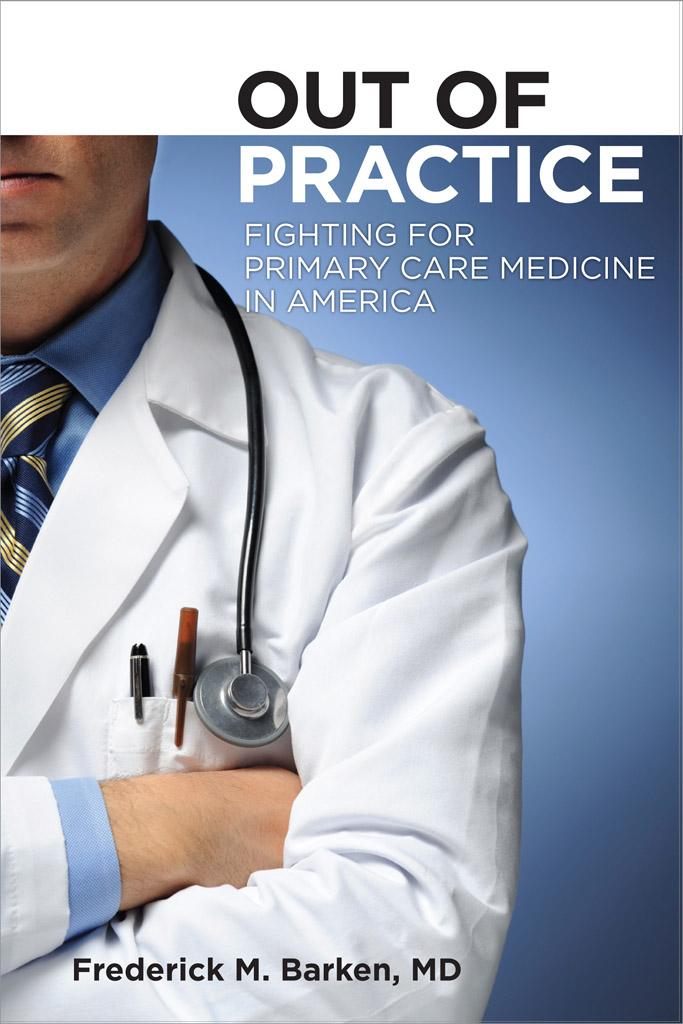
Primary care medicine, as we know and remember it, is in crisis. While policymakers, government administrators, and the health insurance industry pay lip service to the personal relationship between physician and patient, dissatisfaction and disaffection run rampant among primary care doctors, and medical students steer clear in order to pursue more lucrative specialties. Patients feel helpless, well aware that they are losing a valued close connection as health care steadily becomes more transactional than relational. The thin-margin efficiency, rapid pace, and high volume demanded by the new health care economics do not work for primary care, an inherently slower, more personal, and uniquely tailored service.
In Out of Practice, Dr. Frederick Barken juxtaposes his personal experience with the latest research on the transformations in the medical field. He offers a cool critique of the "market model of medicine" while vividly illustrating how the seemingly inexorable trend toward specialization in the last few decades has shifted emphasis away from what was once the foundation of medical practice. Dr. Barken addresses the complexities of modern practice—overuse of diagnostic studies, fragmentation of care, increasing reliance on an array of prescription drugs, and the practice of defensive medicine. He shows how changes in medicine, the family, and society have left physicians to deal with a wide range of geriatric issues, from limited mobility to dementia, that are not addressed by health care policy and are not entirely amenable to a physician's prescription. Indeed, Dr. Barken contends, the very survival of primary care is in jeopardy at a time when its practitioners are needed more than ever.
Illustrated with case studies gleaned from more than twenty years in private practice and data from a wide range of sources, Out of Practice is more than a jeremiad about a broken system. Throughout, Dr. Barken offers cogent suggestions for policymakers and practitioners alike, making clear that as valuable as the latest drug or medical device may be, a successful health care system depends just as much on the doctor-patient relationship embodied by primary care medicine.
Pay easily by card, Klarna, Apple Pay or Google Pay. Not happy? You always have a 14-day money-back guarantee. Read more in our terms. If you have any questions, email us at hello@memmo.org.
Memmo makes studying easier – wherever you are in the world. We bring your course books and smart study tools together in one place: summaries, quizzes, podcasts and flashcards. Plus Ted, your study buddy who answers anything you wonder. Over 75,000 students already study here – built to help you learn faster and stress less.