
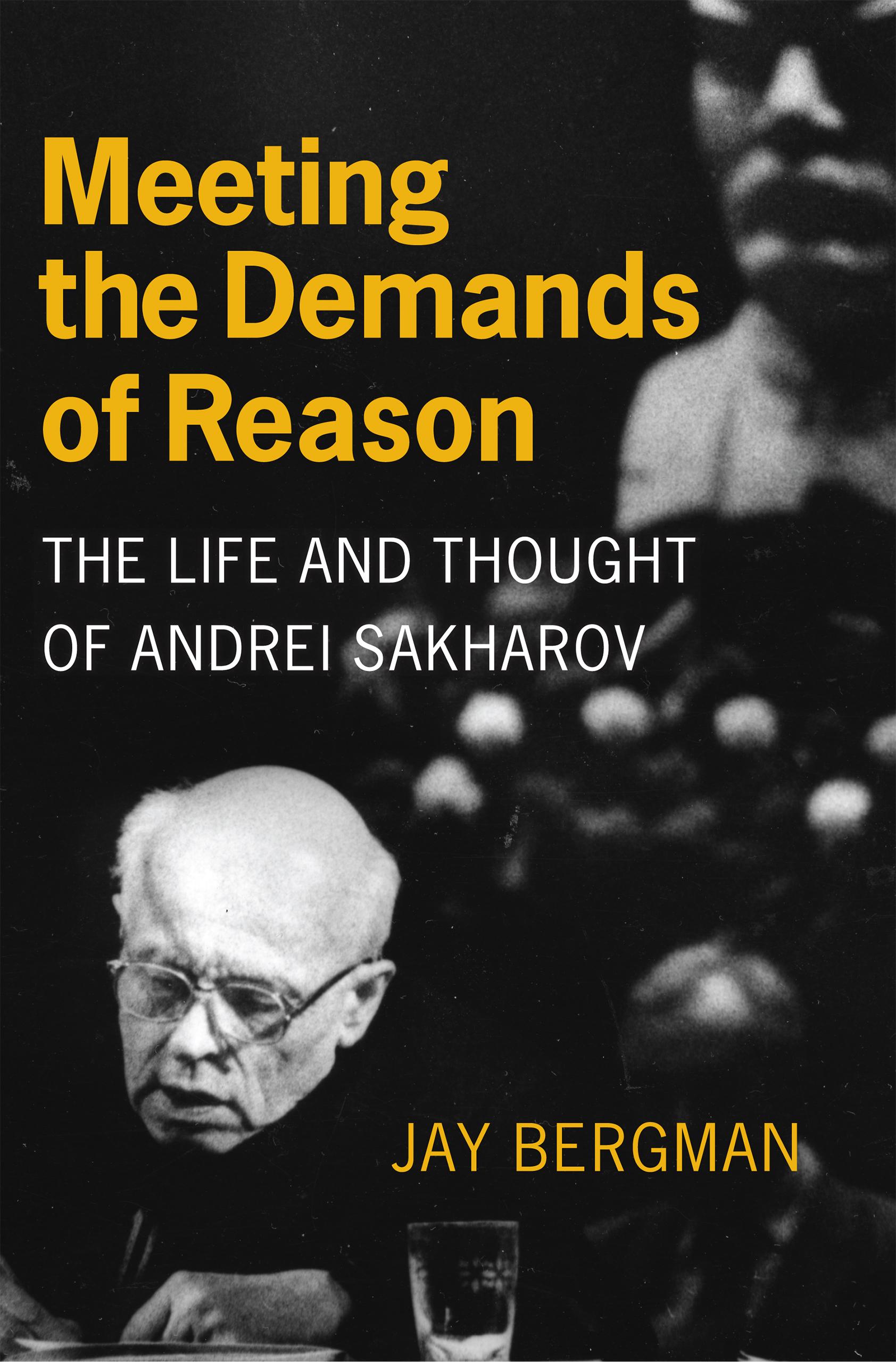
The Soviet physicist, dissident, and human rights activist Andrei Sakharov (1921–1989) was awarded the Nobel Peace Prize in 1975. The first Russian to have been so recognized, Sakharov in his Nobel lecture held that humanity had a "sacred endeavor" to create a life worthy of its potential, that "we must make good the demands of reason," by confronting the dangers threatening the world, both then and now: nuclear annihilation, famine, pollution, and the denial of human rights. Meeting the Demands of Reason provides a comprehensive account of Sakharov's life and intellectual development, focusing on his political thought and the effect his ideas had on Soviet society.
Jay Bergman places Sakharov's dissidence squarely within the ethical legacy of the nineteenth-century Russian intelligentsia, inculcated by his father and other family members from an early age. In 1948, one year after receiving his doctoral candidate's degree in physics, Sakharov began work on the Soviet hydrogen bomb and later received both the Stalin and the Lenin prizes for his efforts. Although as a nuclear physicist he had firsthand experience of honors and privileges inaccessible to ordinary citizens, Sakharov became critical of certain policies of the Soviet government in the late 1950s. He never renounced his work on nuclear weaponry, but eventually grew concerned about the environmental consequences of testing and feared unrestrained nuclear proliferation. Bergman shows that these issues led Sakharov to see the connection between his work in science and his responsibilities to the political life of his country.
In the late 1960s, Sakharov began to condemn the Soviet system as a whole in the name of universal human rights. By the 1970s, he had become, with Alexander Solzhenitsyn, the most recognized Soviet dissident in the West, which afforded him a measure of protection from the authorities. In 1980, however, he was exiled to the closed city of Gorky for protesting the Soviet invasion of Afghanistan. In 1986, the new Gorbachev regime allowed him to return to Moscow, where he played a central role as both supporter and critic in the years of perestroika. Two years after Sakharov's death, the Soviet Union collapsed, and in the courageous example of his unyielding commitment to human rights, skillfully recounted by Bergman, Sakharov remains an enduring inspiration for all those who would tell truth to power.
Pay easily by card, Klarna, Apple Pay or Google Pay. Not happy? You always have a 14-day money-back guarantee. Read more in our terms. If you have any questions, email us at hello@memmo.org.
Memmo makes studying easier – wherever you are in the world. We bring your course books and smart study tools together in one place: summaries, quizzes, podcasts and flashcards. Plus Ted, your study buddy who answers anything you wonder. Over 50,000 students already study here – built to help you learn faster and stress less.