
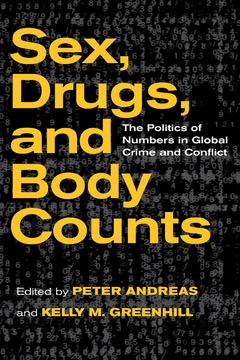
At least 200,000-250,000 people died in the war in Bosnia. "There are three million child soldiers in Africa." "More than 650,000 civilians have been killed as a result of the U.S. occupation of Iraq." "Between 600,000 and 800,000 women are trafficked across borders every year." "Money laundering represents as much as 10 percent of global GDP." "Internet child porn is a $20 billion-a-year industry." These are big, attention-grabbing numbers, frequently used in policy debates and media reporting. Peter Andreas and Kelly M. Greenhill see only one problem: these numbers are probably false. Their continued use and abuse reflect a much larger and troubling pattern: policymakers and the media naively or deliberately accept highly politicized and questionable statistical claims about activities that are extremely difficult to measure. As a result, we too often become trapped by these mythical numbers, with perverse and counterproductive consequences.
This problem exists in myriad policy realms. But it is particularly pronounced in statistics related to the politically charged realms of global crime and conflict-numbers of people killed in massacres and during genocides, the size of refugee flows, the magnitude of the illicit global trade in drugs and human beings, and so on. In Sex, Drugs, and Body Counts, political scientists, anthropologists, sociologists, and policy analysts critically examine the murky origins of some of these statistics and trace their remarkable proliferation. They also assess the standard metrics used to evaluate policy effectiveness in combating problems such as terrorist financing, sex trafficking, and the drug trade.
Pay easily by card, Klarna, Apple Pay or Google Pay. Not happy? You always have a 14-day money-back guarantee. Read more in our terms. If you have any questions, email us at hello@memmo.org.
Memmo makes studying easier – wherever you are in the world. We bring your course books and smart study tools together in one place: summaries, quizzes, podcasts and flashcards. Plus Ted, your study buddy who answers anything you wonder. Over 50,000 students already study here – built to help you learn faster and stress less.