
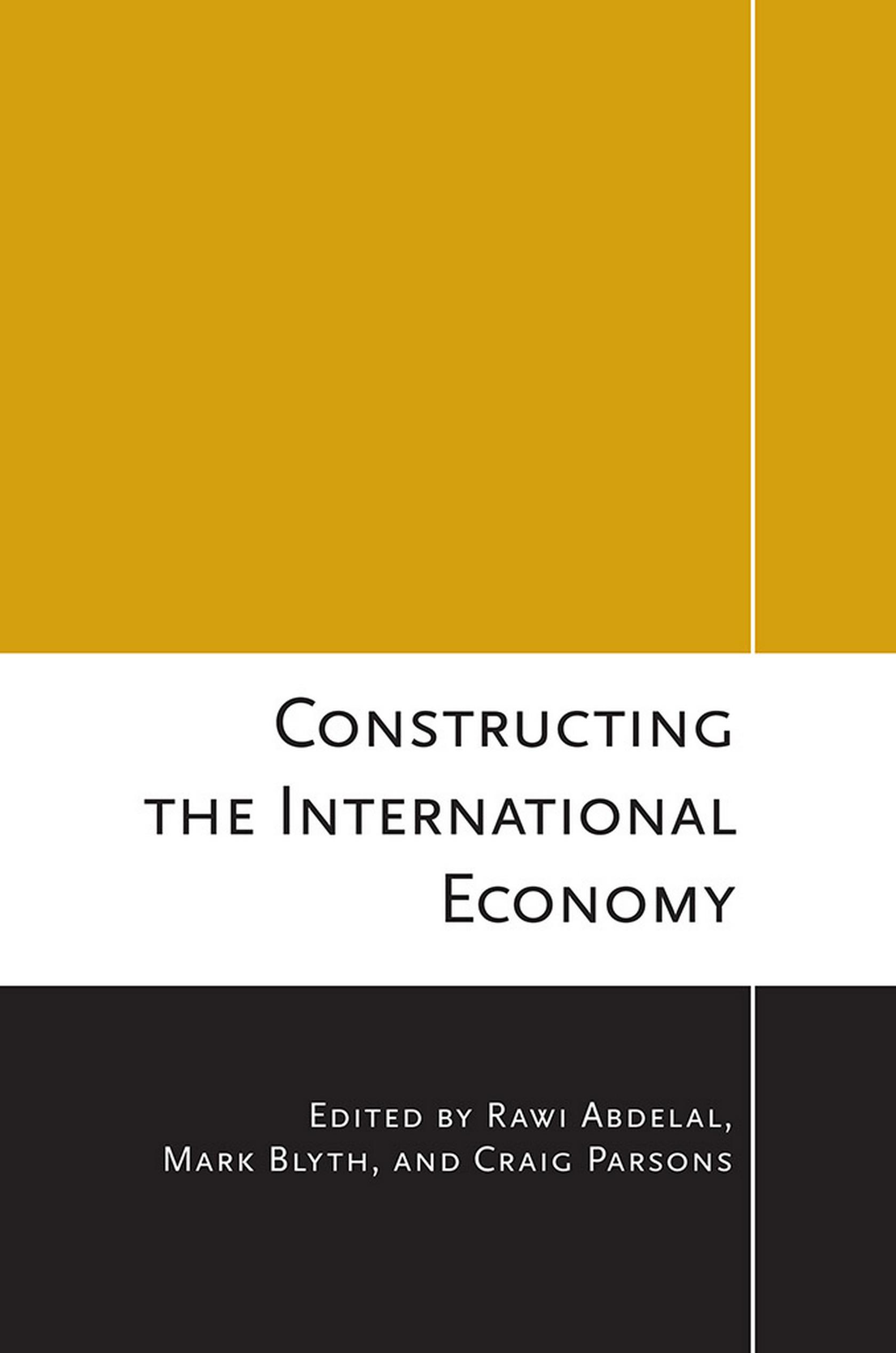
Focusing empirically on how political and economic forces are always mediated and interpreted by agents, both in individual countries and in the international sphere, Constructing the International Economy sets out what such constructions and what various forms of constructivism mean, both as ways of understanding the world and as sets of varying methods for achieving that understanding. It rejects the assumption that material interests either linearly or simply determine economic outcomes and demands that analysts consider, as a plausible hypothesis, that economies might vary substantially for nonmaterial reasons that affect both institutions and agents' interests.
Constructing the International Economy portrays the diversity of models and approaches that exist among constructivists writing on the international political economy. The authors outline and relate several different arguments for why scholars might attend to social construction, inviting the widest possible array of scholars to engage with such approaches. They examine points of terminological or theoretical confusion that create unnecessary barriers to engagement between constructivists and nonconstructivist work and among different types of constructivism. This book provides a tool kit that both constructivists and their critics can use to debate how much and when social construction matters in this deeply important realm.
Pay easily by card, Klarna, Apple Pay or Google Pay. Not happy? You always have a 14-day money-back guarantee. Read more in our terms. If you have any questions, email us at hello@memmo.org.
Memmo makes studying easier – wherever you are in the world. We bring your course books and smart study tools together in one place: summaries, quizzes, podcasts and flashcards. Plus Ted, your study buddy who answers anything you wonder. Over 50,000 students already study here – built to help you learn faster and stress less.