
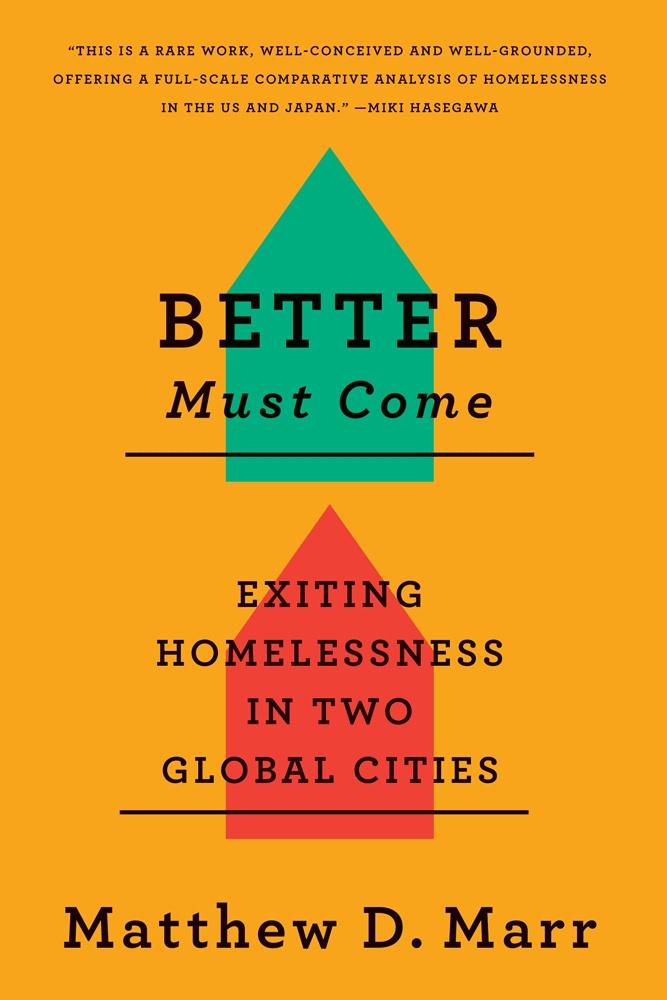
In Better Must Come, Matthew D. Marr reveals how social contexts at various levels combine and interact to shape the experiences of transitional housing program users in two of the most prosperous cities of the global economy, Los Angeles and Tokyo. Marr, who has conducted fieldwork in U.S. and Japanese cities for over two decades, followed the experiences of thirty-four people as they made use of transitional housing services and after they left such programs. This comparative ethnography is groundbreaking in two ways—it is the first book to directly focus on exits from homelessness in American or Japanese cities, and it is the first targeted comparison of homelessness in two global cities.
Marr argues that homelessness should be understood primarily as a socially generated, traumatic, and stigmatizing predicament, rather than as a stable condition, identity, or culture. He pushes for movement away from the study of "homeless people" and "homeless culture" toward an understanding of homelessness as a condition that can be transcended at individual and societal levels. Better Must Come prescribes policy changes to end homelessness that include expanding subsidized housing to persons without disabilities and experiencing homelessness chronically, as well as taking broader measures to address vulnerabilities produced by labor markets, housing markets, and the rapid deterioration of social safety nets that often results from neoliberal globalization.
Pay easily by card, Klarna, Apple Pay or Google Pay. Not happy? You always have a 14-day money-back guarantee. Read more in our terms. If you have any questions, email us at hello@memmo.org.
Memmo makes studying easier – wherever you are in the world. We bring your course books and smart study tools together in one place: summaries, quizzes, podcasts and flashcards. Plus Ted, your study buddy who answers anything you wonder. Over 50,000 students already study here – built to help you learn faster and stress less.