
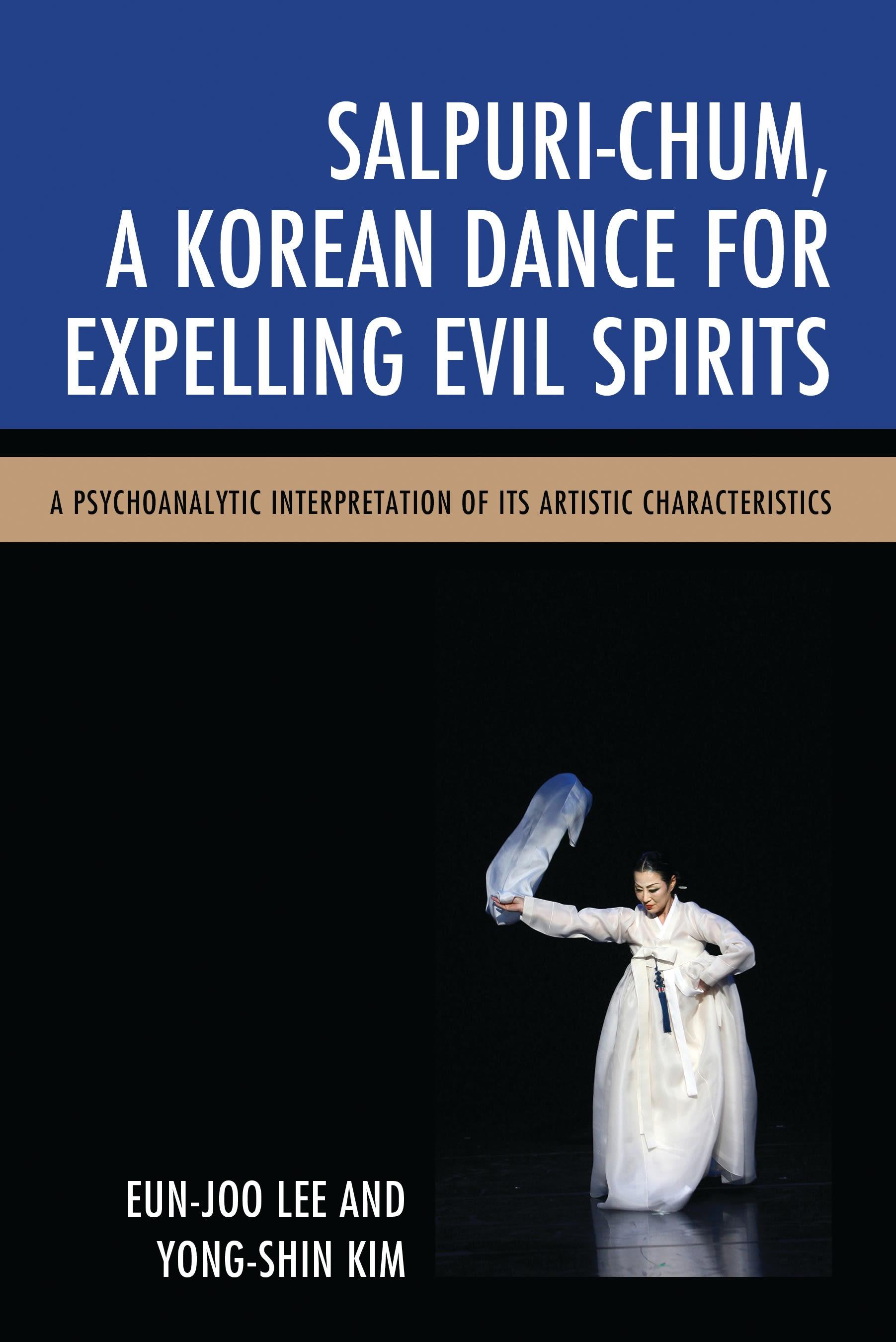
This book is a study of Salpuri-Chum, a traditional Korean dance for expelling evil spirits. The authors explore the origins and practice of Salpuri-Chum. The ancient Korean people viewed their misfortunes as coming from evil spirits; therefore, they wanted to expel the evil spirits to recover their happiness. The music for Salpuri-Chum is called Sinawi rhythm. It has no sheet music and lacks the concept of metronomic technique. In this rhythm, the dancer becomes a conductor.
Salpuri-Chum is an artistic performance that resolves the people’s sorrow. In many cases, it is a form of sublimation. It is also an effort to transform the pain of reality into beauty, based on the Korean people’s characteristic merriment. It presents itself, then, as a form of immanence. Moreover, Salpuri-Chum is unique in its use of a piece of white fabric. The fabric, as a symbol of the Korean people’s ego ideal, signifies Salpuri-Chum’s focus as a dance for resolving their misfortunes.
Salpuri-Chum is an artistic performance that resolves the people’s sorrow. In many cases, it is a form of sublimation. It is also an effort to transform the pain of reality into beauty, based on the Korean people’s characteristic merriment. It presents itself, then, as a form of immanence. Moreover, Salpuri-Chum is unique in its use of a piece of white fabric. The fabric, as a symbol of the Korean people’s ego ideal, signifies Salpuri-Chum’s focus as a dance for resolving their misfortunes.
Pay easily by card, Klarna, Apple Pay or Google Pay. Not happy? You always have a 14-day money-back guarantee. Read more in our terms. If you have any questions, email us at hello@memmo.org.
Memmo makes studying easier – wherever you are in the world. We bring your course books and smart study tools together in one place: summaries, quizzes, podcasts and flashcards. Plus Ted, your study buddy who answers anything you wonder. Over 75,000 students already study here – built to help you learn faster and stress less.