
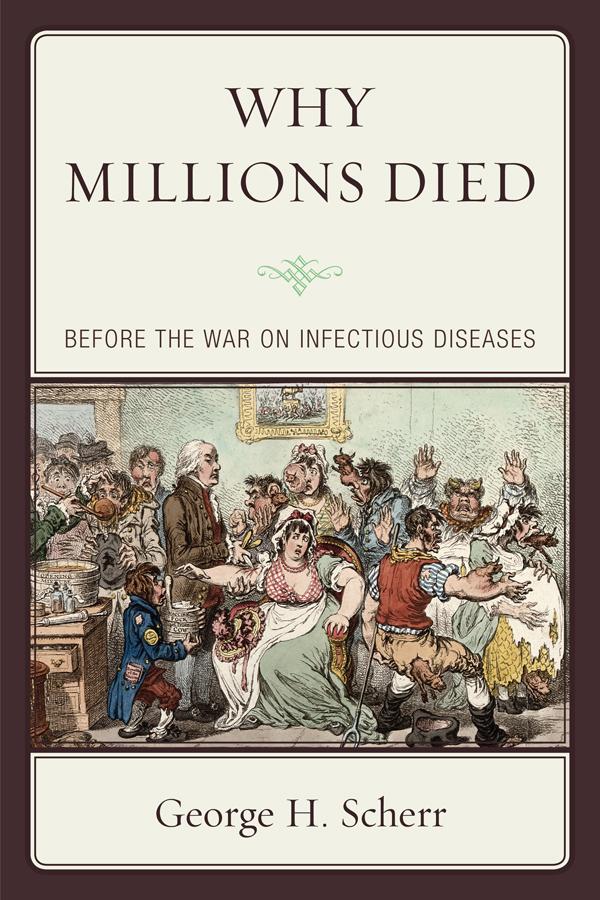
Why Millions Died reviews the painfully slow development of research by isolated investigators who believed that diseases could be caused by infectious organisms. The brutally contentious and vivid arguments that raged between the proponents of the germ theory of disease and those who condemned it from both the scientific community and the pulpits delayed the implementation of vaccines and antimicrobial agents. Such delays resulted in millions of deaths until the professional communities and the general public began to believe that certain health measures could protect against infection and reduce the enormous death tolls from disease. Preeminent among these workers was an Italian scientist, Agostino Bassi, who articulated the germ theory of disease following twenty years of research. Approximately thirty years later, Pasteur repeated Bassi's research in order to gain prestige as the savior of the germ theory of disease. Pasteur was also discovered to have committed fraud in claiming he had developed a vaccine for anthrax - only to be exposed by the brilliant German microbiologist, Robert Koch.
Pay easily by card, Klarna, Apple Pay or Google Pay. Not happy? You always have a 14-day money-back guarantee. Read more in our terms. If you have any questions, email us at hello@memmo.org.
Memmo makes studying easier – wherever you are in the world. We bring your course books and smart study tools together in one place: summaries, quizzes, podcasts and flashcards. Plus Ted, your study buddy who answers anything you wonder. Over 50,000 students already study here – built to help you learn faster and stress less.