
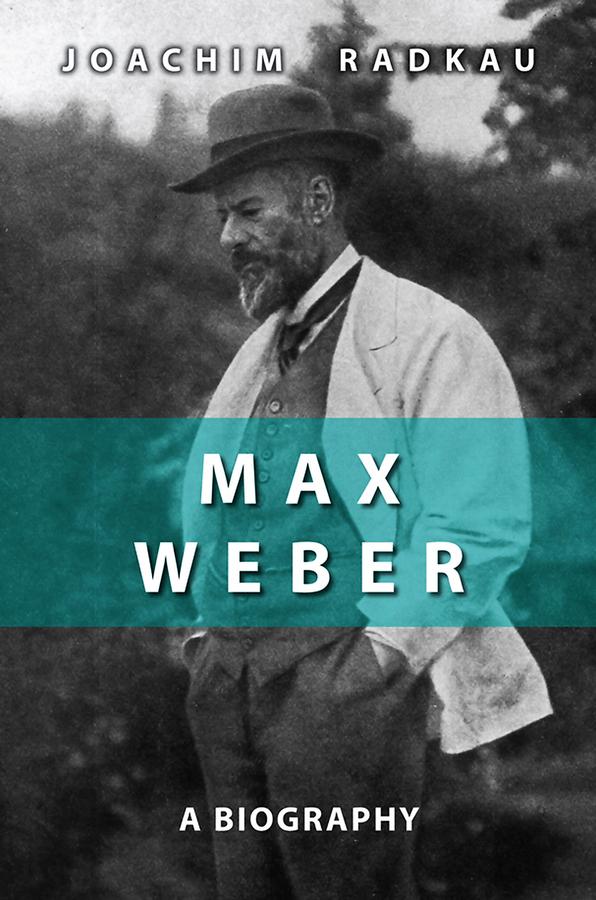
The tremendous influence exerted by Max Weber was due not only to the power of his ideas but also to the fact that behind his theories one perceived a man with a marked character and a tragic destiny. However, for nearly 80 years, our understanding of the life of Max Weber was dominated by the biography published in 1926 by his widow, Marianne Weber. The lack of a great Weber biography was one of the strangest and most glaring gaps in the literature of the social sciences. For various reasons the task was difficult; time and again, attempts to write a new biography of Max Weber ended in failure.
When Joachim Radkau’s biography appeared in Germany in 2005 it caused a sensation. Based on an abundance of previously unknown sources and richly embedded in the German history of the time, this is the first fully comprehensive biography of Max Weber ever to appear. Radkau brings out, in a way that no one has ever done before, the intimate interrelations between Weber’s thought and his life experience. He presents detailed revelations about the great enigmas of Weber’s life: his suffering and erotic experiences, his fears and his desires, his creative power and his methods of work as well as his religious experience and his relation to nature and to death. By understanding the great drama of his life, we discover a new Max Weber, until now unknown in many respects, and, at the same time, we gain a new appreciation of his work.
Joachim Radkau, born in 1943, is Professor of Modern History at the Bielefeld University, Germany. His interest in Max Weber dates back nearly forty years when he worked together with the German-American historian George W. F. Hallgarten (Washington), a refugee who left Germany in 1933 and who, as a student, listened to Weber’s last lecture in summer 1920. Radkau’s main works include Die deutsche Emigration in den USA (1971); Deutsche Industrie und Politik (together with G. W. F. Hallgarten, 1974), Aufstieg und Krise der deutschen Atomwirtschaft (1983), Technik in Deutschland (1989), Das Zeitalter der Nervosität (1998), Natur und Macht: Eine Weltgeschichte der Umwelt (2000).
Pay easily by card, Klarna, Apple Pay or Google Pay. Not happy? You always have a 14-day money-back guarantee. Read more in our terms. If you have any questions, email us at hello@memmo.org.
Memmo makes studying easier – wherever you are in the world. We bring your course books and smart study tools together in one place: summaries, quizzes, podcasts and flashcards. Plus Ted, your study buddy who answers anything you wonder. Over 50,000 students already study here – built to help you learn faster and stress less.