
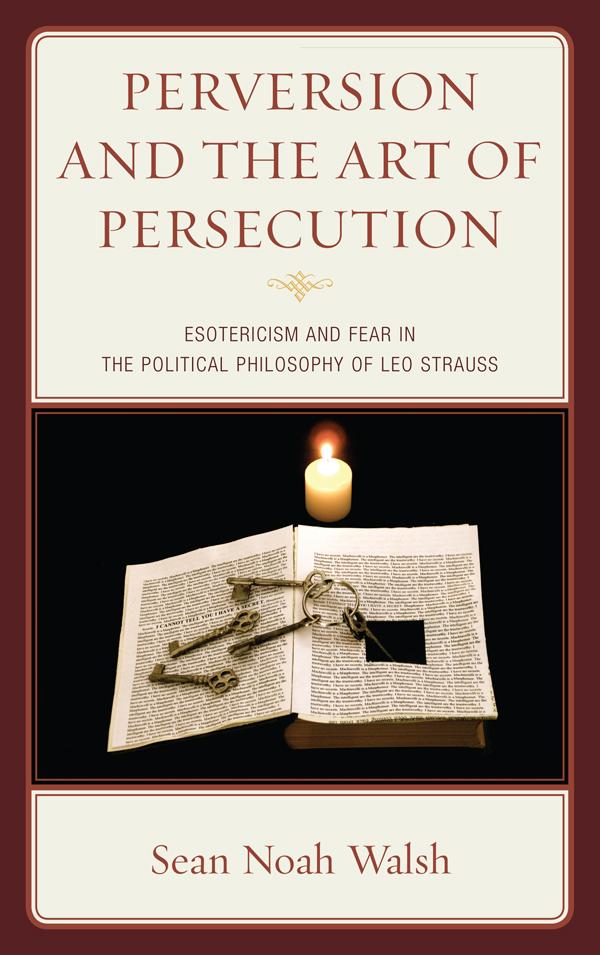
In this critical work on the political thought of Leo Strauss, Sean Noah Walsh addresses Leo Strauss’s claims about esotericism in the philosophic texts of Plato. He challenges Strauss’s understanding of esoteric writing as an attempt by Plato to secretly encode the highest truths “exclusively between the lines” in order to avoid persecution. Indeed, through the character of Socrates, the speaker with whom Plato is inextricably associated, Walsh asserts that Plato’s exoteric writings were sufficiently incendiary and provocative to demonstrate that a fear of persecution was not his highest priority. The politics that follow from Strauss’s thought depend on the interpretation of these Platonic philosophical bases and by analyzing how the problem of fear has been confronted in the works of Plato and Leo Strauss, Walsh offers a direct and thorough account of the politics that emerge from Strauss’s esoteric reading of political philosophy.
Applying Lacanian psychoanalysis, Walsh investigates the discourse of Straussian esotericism. and examines Plato’s writing for examples of exoteric risk, subjecting both Plato and Strauss’s writings to Lacan's psychoanalytic technique for interpreting the function of desire in discourse. Given the continuing influence of Strauss’s ideas on contemporary politics, particularly within American foreign policy, Walsh’s examination of this Straussian esotericism for these effects will prove an interesting read for political theorists, international relations scholars, and philosophers alike.
Applying Lacanian psychoanalysis, Walsh investigates the discourse of Straussian esotericism. and examines Plato’s writing for examples of exoteric risk, subjecting both Plato and Strauss’s writings to Lacan's psychoanalytic technique for interpreting the function of desire in discourse. Given the continuing influence of Strauss’s ideas on contemporary politics, particularly within American foreign policy, Walsh’s examination of this Straussian esotericism for these effects will prove an interesting read for political theorists, international relations scholars, and philosophers alike.
Pages: 192
Category: Statsvetenskap & Politik
e-ISBN: 9780739171813
Shipping weight: 1.2 kg
Ships in: 1-2 days
Pay easily by card, Klarna, Apple Pay or Google Pay. Not happy? You always have a 14-day money-back guarantee. Read more in our terms. If you have any questions, email us at hello@memmo.org.
Memmo makes studying easier – wherever you are in the world. We bring your course books and smart study tools together in one place: summaries, quizzes, podcasts and flashcards. Plus Ted, your study buddy who answers anything you wonder. Over 50,000 students already study here – built to help you learn faster and stress less.