
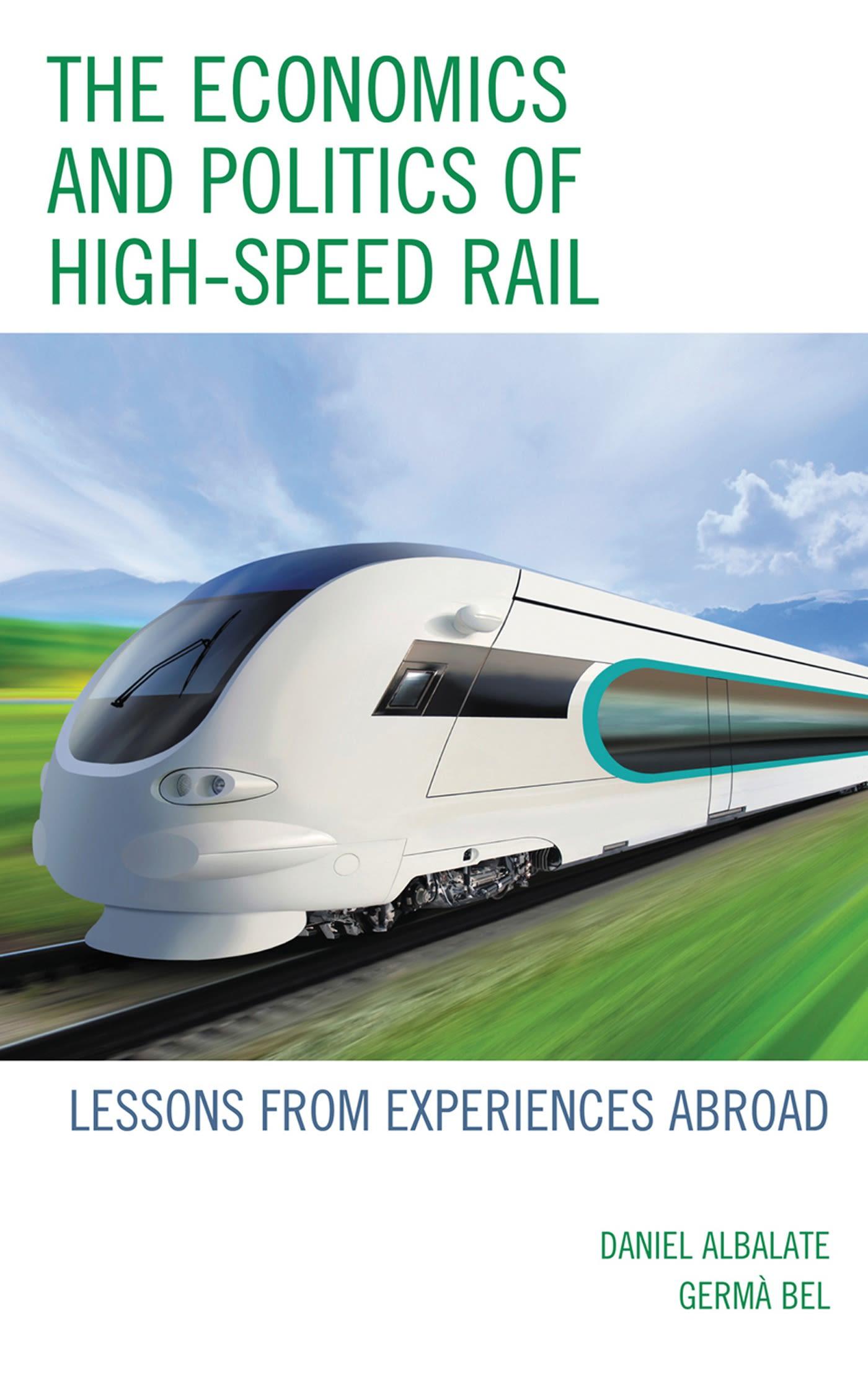
The technological revolution linked to high speed rail (HSR) has been accompanied by myths and claims about its contribution to society and the economy. Although HSR is unquestionably a technological advance that has become a symbol of modernity, this review and analysis of the international experiences shows that the conditions necessary to have a positive impact, economically, socially and environmentally, are enormously restrictive. The Economics and Politics of High Speed Rail: Lessons from Experiences Abroad, by Daniel Albalate and Germà Bel, introduces the main questions policy makers and scholars should examine when considering and studying HSR implementation, with particular emphasis on the US’s recent interest in this technology and possible application in California. Albalate and Bel then review the experiences of the most significant implementations of HSR around the globe. This in-depth international perspective includes chapters on the pioneers of HSR (Japan and France), the European followers (Germany, Spain and Italy), as well as Asian experiences in China, Taiwan, and Korea.
Albalate and Bel’s study provides a clear distinction between the myths and realities associated with this transportation innovation. Among the most relevant findings, this study highlights how HSR projects that do not satisfy highly restrictive conditions—on mobility patterns, measured costs, and economically rational designs—that make it desirable have been the source of huge financial debacles and the economic failure of HSR in most cases, which result in unfortunate consequences for taxpayers. The Economics and Politics of High Speed Rail is a rigorous investigation of the economic and political challenges and ramifications of implementing new public transportation technology.
Albalate and Bel’s study provides a clear distinction between the myths and realities associated with this transportation innovation. Among the most relevant findings, this study highlights how HSR projects that do not satisfy highly restrictive conditions—on mobility patterns, measured costs, and economically rational designs—that make it desirable have been the source of huge financial debacles and the economic failure of HSR in most cases, which result in unfortunate consequences for taxpayers. The Economics and Politics of High Speed Rail is a rigorous investigation of the economic and political challenges and ramifications of implementing new public transportation technology.
Pay easily by card, Klarna, Apple Pay or Google Pay. Not happy? You always have a 14-day money-back guarantee. Read more in our terms. If you have any questions, email us at hello@memmo.org.
Memmo makes studying easier – wherever you are in the world. We bring your course books and smart study tools together in one place: summaries, quizzes, podcasts and flashcards. Plus Ted, your study buddy who answers anything you wonder. Over 75,000 students already study here – built to help you learn faster and stress less.