
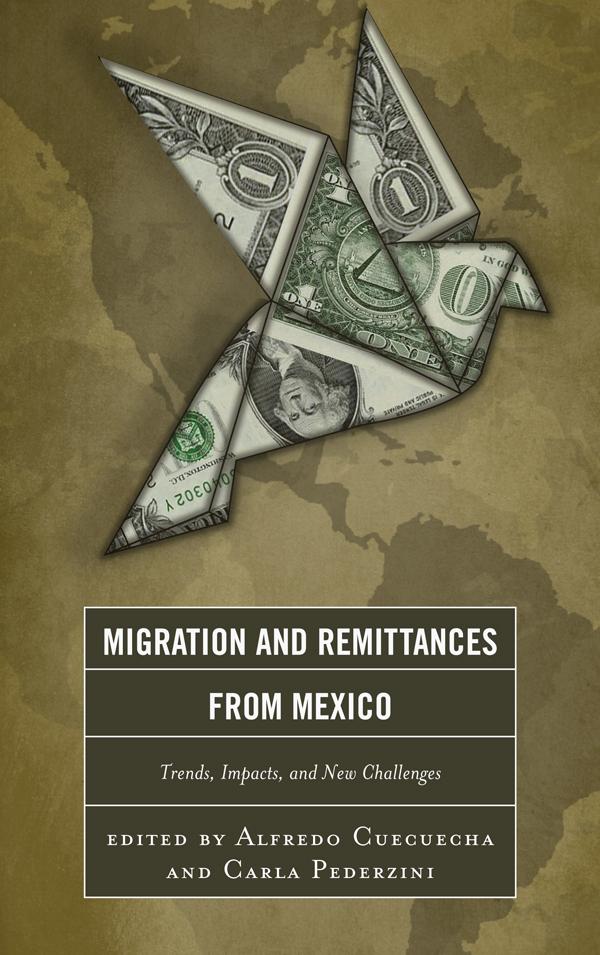
Migration and Remittances from Mexico: Trends, Impacts, and New Challenges, edited by Alfredo Cuecuecha and Carla Pederzini, compiles twelve articles on the migration phenomenon from Mexico and other Latin American countries to the United States.
The first part of the book provides an overview of three recent surveys, all carried out in Mexico. The surveys consider international migration flows from Mexico to the United States, the characteristics of migrants, and some of the causes and effects of migration in Mexico both for national and rural samples. The next section of the book analyzes the factors that explain the relationship between internal migration and human development. Then, the authors look at different issues of migration from Mexico and Latin American countries to the United States. The topics include female educational selection in migrants from Mexico to the United States, the impact of differences in the U.S.-Mexico labor market outcomes on the migratory flow, the working conditions of Mexican migrants to the United States under H2 visas, and the breadth and depth of migrants' connections from Latin American countries to the United States. The fourth and final section of the book studies a variety of aspects related to remittances from United States to Mexico and Latin American countries, including whether remittances promote growth in Mexico, whether remittances sent to Mexico finance migration of more Mexicans to the United States, and whether remittances have positive impacts in the households that receive them.
The contributors to Migration and Remittances from Mexico are specialized migration researchers, trained in a broad variety of fields, including economics, sociology, demography, and political science in both Mexico and the United States. This range of backgrounds provides an essential multidisciplinary perspective from both sides of the border.
The first part of the book provides an overview of three recent surveys, all carried out in Mexico. The surveys consider international migration flows from Mexico to the United States, the characteristics of migrants, and some of the causes and effects of migration in Mexico both for national and rural samples. The next section of the book analyzes the factors that explain the relationship between internal migration and human development. Then, the authors look at different issues of migration from Mexico and Latin American countries to the United States. The topics include female educational selection in migrants from Mexico to the United States, the impact of differences in the U.S.-Mexico labor market outcomes on the migratory flow, the working conditions of Mexican migrants to the United States under H2 visas, and the breadth and depth of migrants' connections from Latin American countries to the United States. The fourth and final section of the book studies a variety of aspects related to remittances from United States to Mexico and Latin American countries, including whether remittances promote growth in Mexico, whether remittances sent to Mexico finance migration of more Mexicans to the United States, and whether remittances have positive impacts in the households that receive them.
The contributors to Migration and Remittances from Mexico are specialized migration researchers, trained in a broad variety of fields, including economics, sociology, demography, and political science in both Mexico and the United States. This range of backgrounds provides an essential multidisciplinary perspective from both sides of the border.
Pages: 302
Category: Ekonomi & Utveckling
e-ISBN: 9780739169803
Shipping weight: 1.2 kg
Ships in: 1-2 days
Pay easily by card, Klarna, Apple Pay or Google Pay. Not happy? You always have a 14-day money-back guarantee. Read more in our terms. If you have any questions, email us at hello@memmo.org.
Memmo makes studying easier – wherever you are in the world. We bring your course books and smart study tools together in one place: summaries, quizzes, podcasts and flashcards. Plus Ted, your study buddy who answers anything you wonder. Over 50,000 students already study here – built to help you learn faster and stress less.