
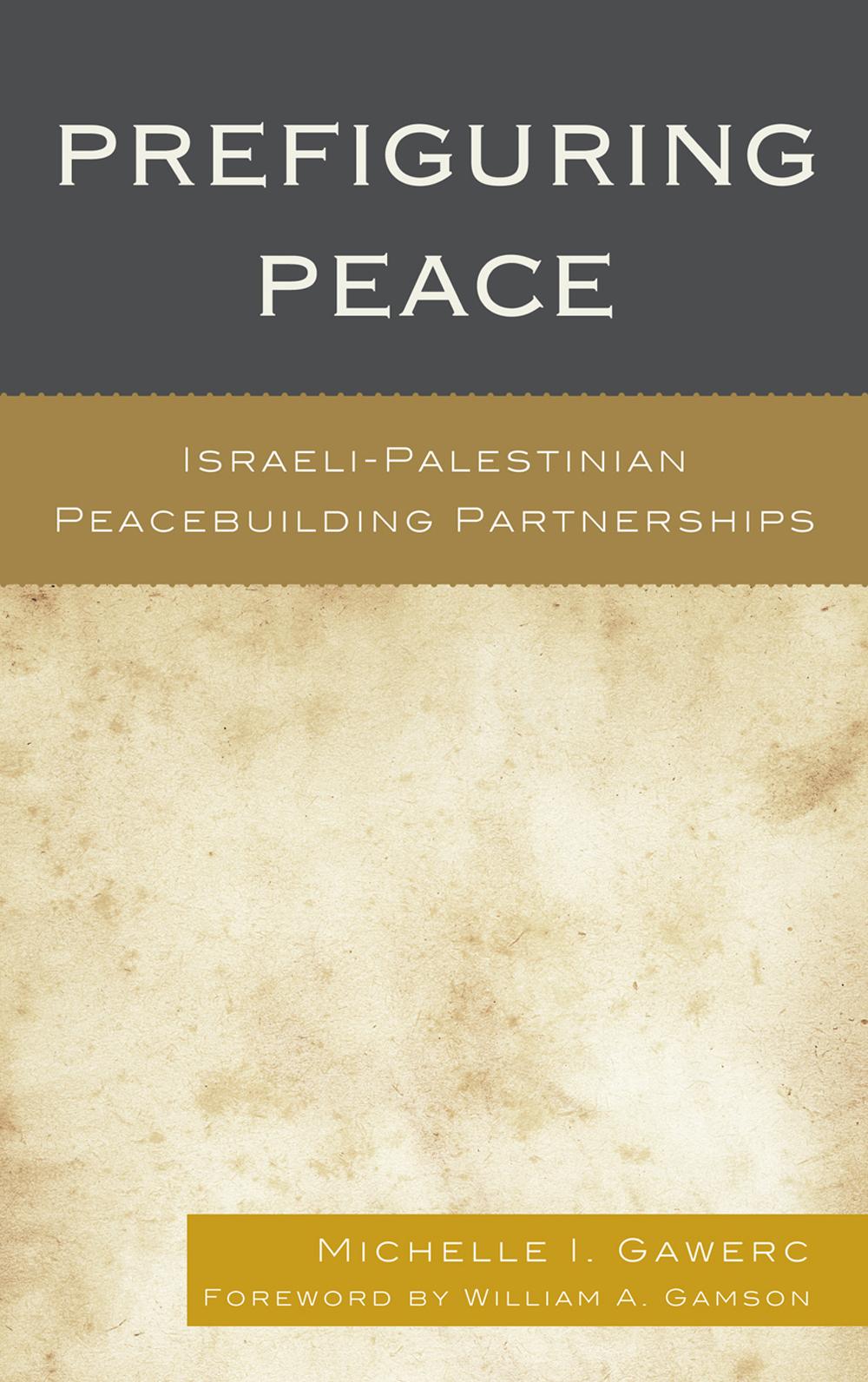
Prefiguring Peace: Israeli-Palestinian Peacebuilding Partnerships, a longitudinal study of more than ten years (1993–2008), focuses on the major peacebuilding initiatives with an educational encounter-based approach in Israel and Palestine. It examines how non-governmental peacebuilding initiatives adapt to radically changing environments, the challenges they face, and why some are able to adapt and survive while others do not. Michelle I. Gawerc explores two aspects of adaptation—the ability to maintain resources and legitimacy with critical constituencies outside the organization, and the ability to continue to function effectively as an organization.
Her study shows that when the environment became more tumultuous and hostile, the effectiveness and even survival of these organizations depended to a significant degree on their ability to manage the power asymmetry between the two sides and work as equally as possible. Indeed, it became critical for building and maintaining trust and respect in the partnership; for preserving legitimacy with one’s partner; for maintaining staff and active participant commitment; for managing internal conflict; and even for managing resources. Organizations that failed to deal effectively with matters of equality, and the needs and desires of both sides, ended up struggling to maintain commitment or were doused in conflict that could have been tempered if they strived for more equality.
Encompassing various fields, this research contributes to the broad fields of peace and conflict resolution, social movements, and organizational studies. It offers critical insight into how organizations adapt to sudden and drastic changes: what is problematic, what is possible, and what allows some groups to survive while others do not. In addition, it has great import for building sustainable coalitions across inequality, asymmetry, and difference.
Her study shows that when the environment became more tumultuous and hostile, the effectiveness and even survival of these organizations depended to a significant degree on their ability to manage the power asymmetry between the two sides and work as equally as possible. Indeed, it became critical for building and maintaining trust and respect in the partnership; for preserving legitimacy with one’s partner; for maintaining staff and active participant commitment; for managing internal conflict; and even for managing resources. Organizations that failed to deal effectively with matters of equality, and the needs and desires of both sides, ended up struggling to maintain commitment or were doused in conflict that could have been tempered if they strived for more equality.
Encompassing various fields, this research contributes to the broad fields of peace and conflict resolution, social movements, and organizational studies. It offers critical insight into how organizations adapt to sudden and drastic changes: what is problematic, what is possible, and what allows some groups to survive while others do not. In addition, it has great import for building sustainable coalitions across inequality, asymmetry, and difference.
Pay easily by card, Klarna, Apple Pay or Google Pay. Not happy? You always have a 14-day money-back guarantee. Read more in our terms. If you have any questions, email us at hello@memmo.org.
Memmo makes studying easier – wherever you are in the world. We bring your course books and smart study tools together in one place: summaries, quizzes, podcasts and flashcards. Plus Ted, your study buddy who answers anything you wonder. Over 50,000 students already study here – built to help you learn faster and stress less.