
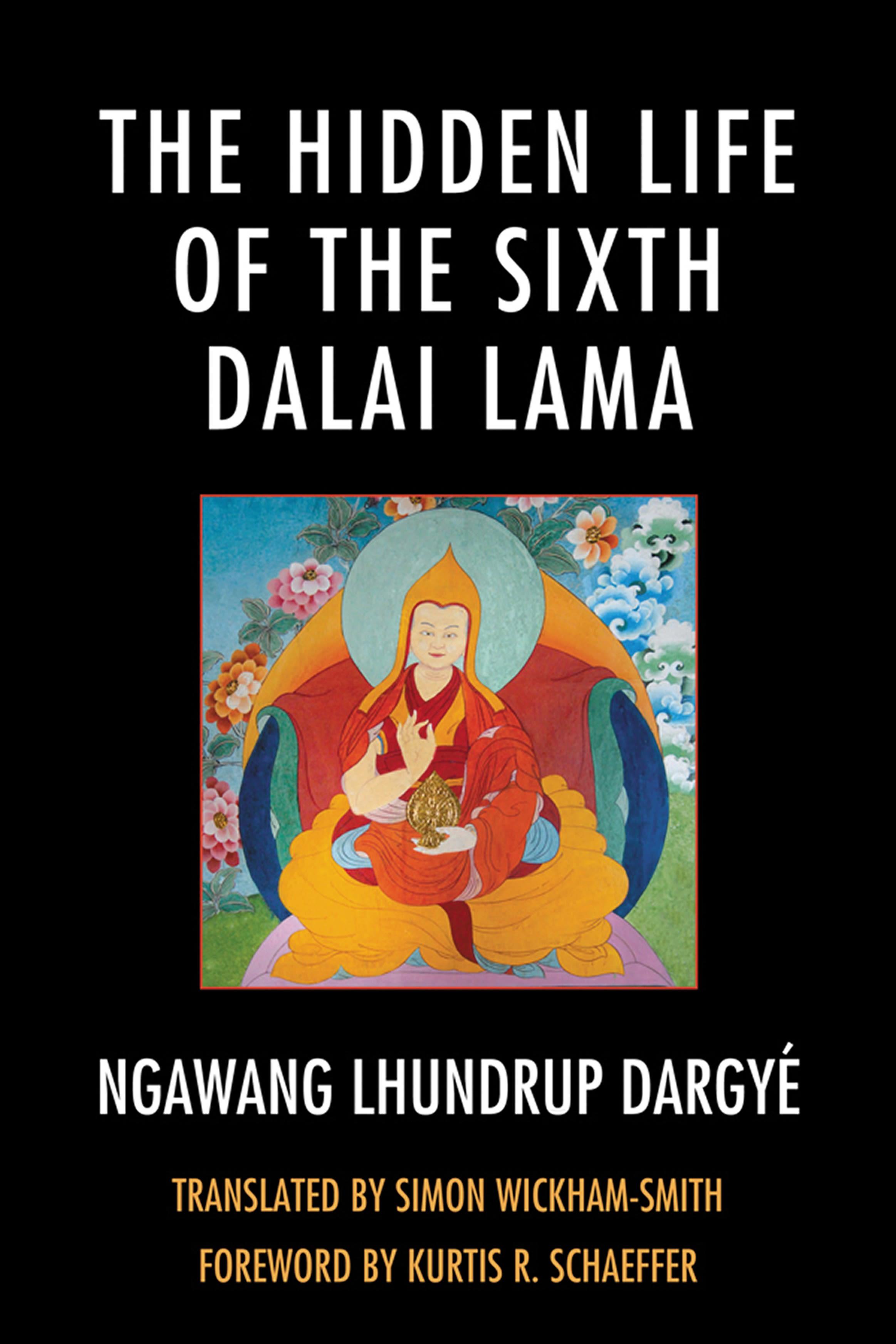
The life of the Sixth Dalai Lama does not end with his supposed death at Kokonor in November 1706, on the way to Beijing, and an audience with the Manchu Emperor Kangxi. This book, the so-called Hidden Life, presents a very different Tsangyang Gyamtso, neither a louche poet nor a drinker, but a sober Buddhist practitioner, who chose to escape at Kokonor and to adopt the guise of a wandering monk, only appearing some years later, after many fantastical and mystical adventures, in what is today Inner Mongolia, where he oversaw monasteries and lived as a Buddhist teacher.
The Hidden Life was written by a Mongolian monk in 1756, ten years following the death of the lama, his spiritual teacher, whom he identifies as Tsangyang Gyamtso, and in whose identity as the Sixth Dalai Lama he clearly has complete faith. However, as one might imagine, there is nowadays no agreement among the wider Tibetan, Mongolian and Tibetological scholarly community as to whether this man was a charlatan or deluded, or whether he was indeed the Sixth Dalai Lama.
The text is divided into four parts. The first part gives an account of the background and birth of the Sixth Dalai Lama, while the opening section of the second part (which is in direct speech, dictated by the lama) continues on, through the political intrigue in Lhasa at the end of the seventeenth century, to the lama's escape at Kokonor.
The remainder of the second part consists of a visionary narrative, in which the lama travels through Tibet and Nepal, and in which he encounters divine figures, yetis, zombies and a man with no head, all of which is presented as fact. The third and longest part is an account of the final thirty years of the lama's life, and his activity in Mongolia as an influential Buddhist teacher, including a lengthy and moving description of his death. The final part includes a list of his students and, most interestingly perhaps, a theological and philosophical justification for the coexistence of the Sixth and Seventh Dalai Lamas.
The Hidden Life was written by a Mongolian monk in 1756, ten years following the death of the lama, his spiritual teacher, whom he identifies as Tsangyang Gyamtso, and in whose identity as the Sixth Dalai Lama he clearly has complete faith. However, as one might imagine, there is nowadays no agreement among the wider Tibetan, Mongolian and Tibetological scholarly community as to whether this man was a charlatan or deluded, or whether he was indeed the Sixth Dalai Lama.
The text is divided into four parts. The first part gives an account of the background and birth of the Sixth Dalai Lama, while the opening section of the second part (which is in direct speech, dictated by the lama) continues on, through the political intrigue in Lhasa at the end of the seventeenth century, to the lama's escape at Kokonor.
The remainder of the second part consists of a visionary narrative, in which the lama travels through Tibet and Nepal, and in which he encounters divine figures, yetis, zombies and a man with no head, all of which is presented as fact. The third and longest part is an account of the final thirty years of the lama's life, and his activity in Mongolia as an influential Buddhist teacher, including a lengthy and moving description of his death. The final part includes a list of his students and, most interestingly perhaps, a theological and philosophical justification for the coexistence of the Sixth and Seventh Dalai Lamas.
Pages: 170
Category: Biografi & Memoarer
e-ISBN: 9780739150559
Shipping weight: 1.2 kg
Ships in: 1-2 days
Pay easily by card, Klarna, Apple Pay or Google Pay. Not happy? You always have a 14-day money-back guarantee. Read more in our terms. If you have any questions, email us at hello@memmo.org.
Memmo makes studying easier – wherever you are in the world. We bring your course books and smart study tools together in one place: summaries, quizzes, podcasts and flashcards. Plus Ted, your study buddy who answers anything you wonder. Over 50,000 students already study here – built to help you learn faster and stress less.