
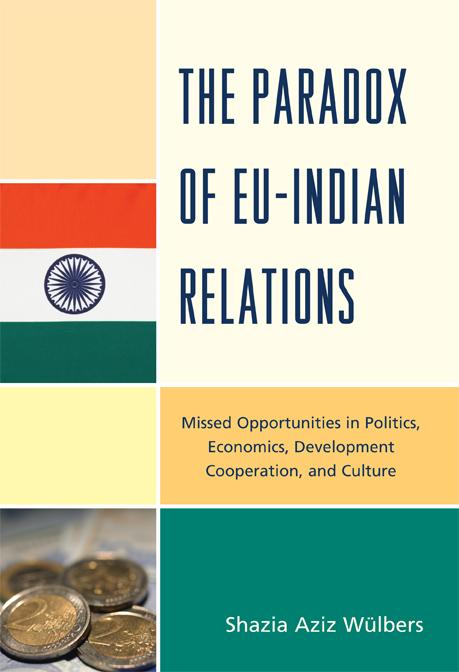
The Paradox of EU-India Relations: Missed Opportunities in Politics, Economics, Development Cooperation, and Culture, by Shazia Aziz Wülbers, discusses areas where EU-Indian relations are strained and areas where there is meaningful cooperation, and then situates those areas within the broader context of international relations. Wülbers also considers the United States in her study, as much can be learned from comparing EU-India relations with that of the U.S. and India. She addresses the primary issues confronting the EU and India in both the past and in the present, from politics and economics to each entity's role in global technological advances, finishing with a careful discussion of the role of cultural interactions in EU-India relations.
Wülbers also looks to the future when she conducts an analysis of policy convergence and divergence to detect upcoming trends between the EU and India. She uses this analysis to make recommendations for policy makers about the way forward.
The Paradox of EU-India Relations: Missed Opportunities in Politics, Economics, Development Cooperation, and Culture, by Shazia Aziz Wülbers, successfully identifies problems and prospects in the relationship between two great entities. It is a comprehensive empirical study which ultimately indicates that the Indian worldview is undeniably different from the European Union worldview, and could therefore be the important cause for problematic divergences in foreign policy trends.
Wülbers also looks to the future when she conducts an analysis of policy convergence and divergence to detect upcoming trends between the EU and India. She uses this analysis to make recommendations for policy makers about the way forward.
The Paradox of EU-India Relations: Missed Opportunities in Politics, Economics, Development Cooperation, and Culture, by Shazia Aziz Wülbers, successfully identifies problems and prospects in the relationship between two great entities. It is a comprehensive empirical study which ultimately indicates that the Indian worldview is undeniably different from the European Union worldview, and could therefore be the important cause for problematic divergences in foreign policy trends.
Pages: 200
Category: Statsvetenskap & Politik
e-ISBN: 9780739148112
Shipping weight: 1.2 kg
Ships in: 1-2 days
Pay easily by card, Klarna, Apple Pay or Google Pay. Not happy? You always have a 14-day money-back guarantee. Read more in our terms. If you have any questions, email us at hello@memmo.org.
Memmo makes studying easier – wherever you are in the world. We bring your course books and smart study tools together in one place: summaries, quizzes, podcasts and flashcards. Plus Ted, your study buddy who answers anything you wonder. Over 50,000 students already study here – built to help you learn faster and stress less.