
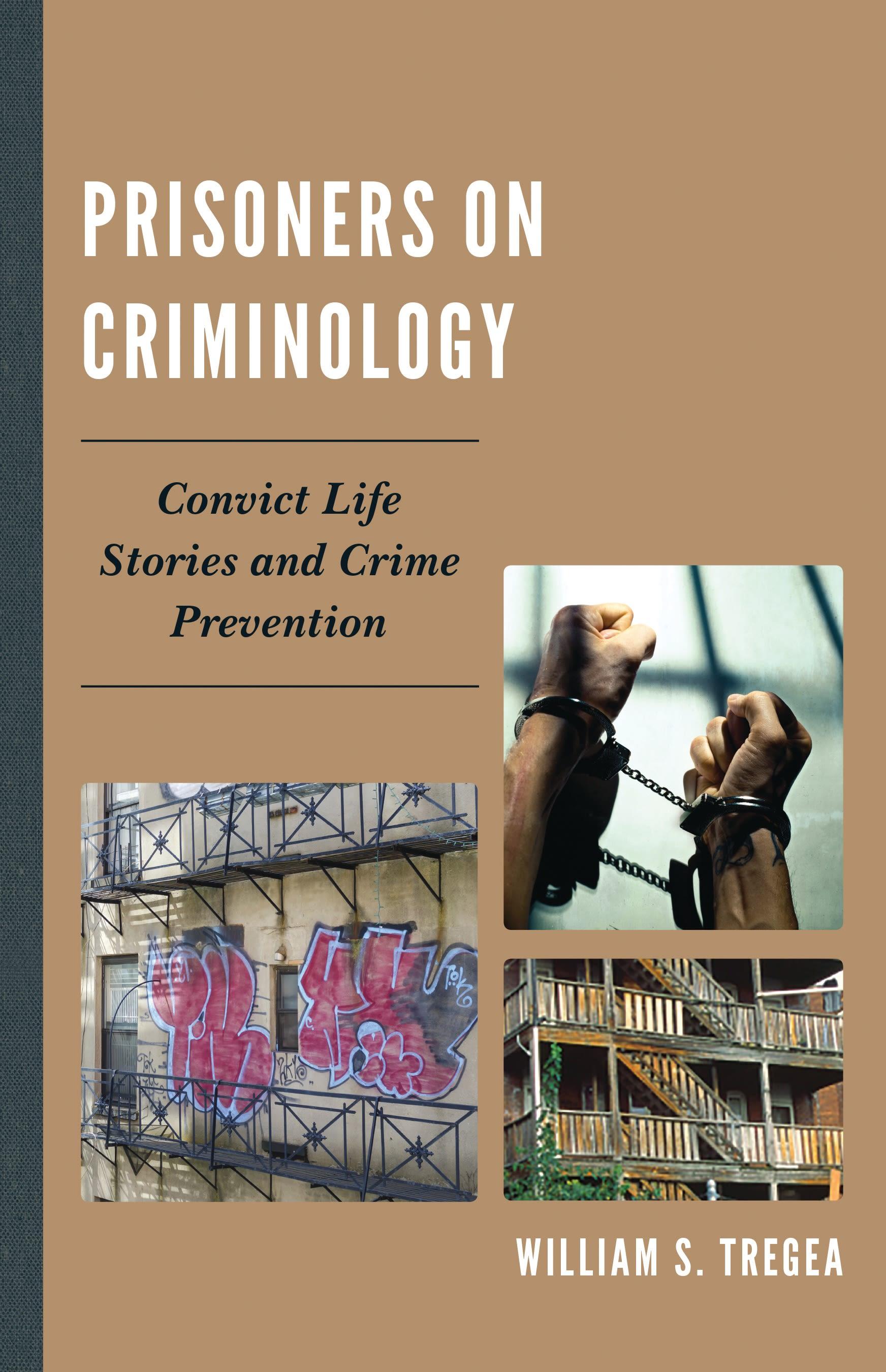
Drawing on thirty years of prison college courses and volunteer classes in eleven Michigan and California prisons, Prisoners on Criminology: Convict Life Stories and Crime Prevention makes criminology theories come alive through the use of the prisoners’ voices.
The book features policy background and textbook-like chapters that review major criminological theories and present prisoner essays that apply criminology insights to the prisoners’ lives. Each chapter has helpful exercises and discussion and review questions for classroom use.
Introductory informational chapters present an historical review of how the United States came to have the world’s largest prison system. A chapter on prisoners’ educational background presents information from prisoner surveys and the author’s extensive background in postsecondary correctional education. Over eighty prisoner essays show how prisoners connect criminology theories to their lives growing up, with insights on individual, family, and community levels of crime causation.
A chapter on social structure, social process and alternative criminologies is followed by additional information on in-prison criminological issues with several prisoner essays. The conclusion emphasizes the main argument of the book—that the jobless ghetto is a major reason for much of the criminality now in the large correctional apparatus of the United States.
Prisoners on Criminology will be of great value to scholars and students interested in criminology, social deviance, sociology, urban studies, political science, anthropology, counseling, and social work.
The book features policy background and textbook-like chapters that review major criminological theories and present prisoner essays that apply criminology insights to the prisoners’ lives. Each chapter has helpful exercises and discussion and review questions for classroom use.
Introductory informational chapters present an historical review of how the United States came to have the world’s largest prison system. A chapter on prisoners’ educational background presents information from prisoner surveys and the author’s extensive background in postsecondary correctional education. Over eighty prisoner essays show how prisoners connect criminology theories to their lives growing up, with insights on individual, family, and community levels of crime causation.
A chapter on social structure, social process and alternative criminologies is followed by additional information on in-prison criminological issues with several prisoner essays. The conclusion emphasizes the main argument of the book—that the jobless ghetto is a major reason for much of the criminality now in the large correctional apparatus of the United States.
Prisoners on Criminology will be of great value to scholars and students interested in criminology, social deviance, sociology, urban studies, political science, anthropology, counseling, and social work.
Pay easily by card, Klarna, Apple Pay or Google Pay. Not happy? You always have a 14-day money-back guarantee. Read more in our terms. If you have any questions, email us at hello@memmo.org.
Memmo makes studying easier – wherever you are in the world. We bring your course books and smart study tools together in one place: summaries, quizzes, podcasts and flashcards. Plus Ted, your study buddy who answers anything you wonder. Over 50,000 students already study here – built to help you learn faster and stress less.