
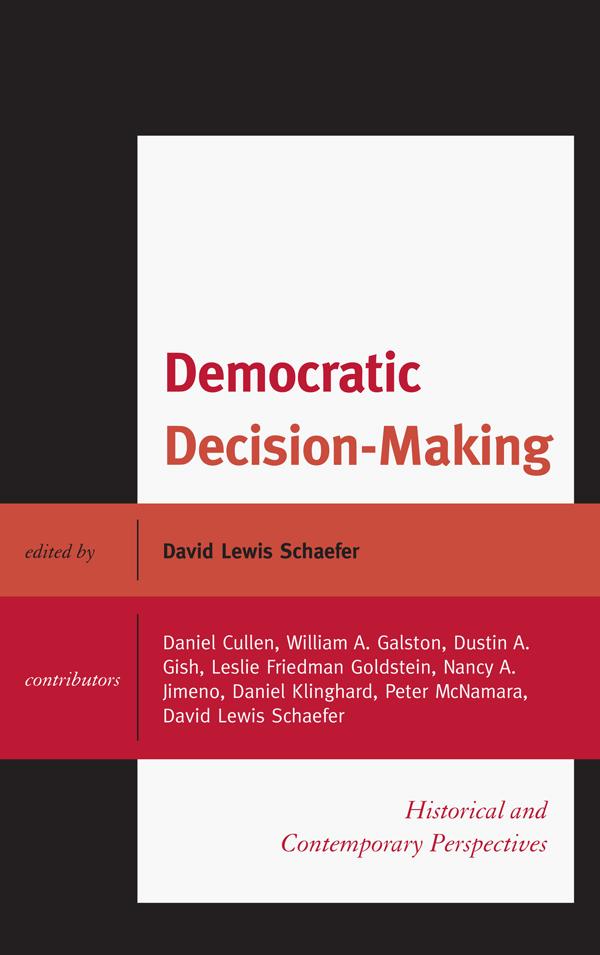
Democratic Decision-Making: Historical and Contemporary Perspectives contains eight essays by political scientists addressing various aspects of the democratic decision-making process. The book is divided into four parts: democratic statesmanship, the extent to which limitations of the democratic principle of majority rule are desirable, the contemporary doctrine of “deliberative democracy,” and informal modes of democratic decision-making.
Under these four headings, the contributors discuss a wide variety of issues, including the practice of “political opportunism” by such statesmen as Hamilton and Madison; the historical development of legal restraints on democracy in America ranging from judicial review (during the colonial period) to the filibuster; the operation of classical Athenian democracy, the defects of which may have been exaggerated by the American Founders; the significance of the reflections of Tammany Hall boss George Washington Plunkitt for the development of the American party system; the relation of deliberative-democracy theory to the thought of Rousseau; and the means by which cooperative land-use agreements have been arrived at in California, eliciting the voluntary consent of the affected parties instead of relying on judicial or bureaucratic dictates. The book is well-suited for use in courses on American political thought, democratic theory, American political development, and related subjects.
Under these four headings, the contributors discuss a wide variety of issues, including the practice of “political opportunism” by such statesmen as Hamilton and Madison; the historical development of legal restraints on democracy in America ranging from judicial review (during the colonial period) to the filibuster; the operation of classical Athenian democracy, the defects of which may have been exaggerated by the American Founders; the significance of the reflections of Tammany Hall boss George Washington Plunkitt for the development of the American party system; the relation of deliberative-democracy theory to the thought of Rousseau; and the means by which cooperative land-use agreements have been arrived at in California, eliciting the voluntary consent of the affected parties instead of relying on judicial or bureaucratic dictates. The book is well-suited for use in courses on American political thought, democratic theory, American political development, and related subjects.
Pages: 196
Category: Statsvetenskap & Politik
e-ISBN: 9780739142080
Shipping weight: 1.2 kg
Ships in: 1-2 days
Pay easily by card, Klarna, Apple Pay or Google Pay. Not happy? You always have a 14-day money-back guarantee. Read more in our terms. If you have any questions, email us at hello@memmo.org.
Memmo makes studying easier – wherever you are in the world. We bring your course books and smart study tools together in one place: summaries, quizzes, podcasts and flashcards. Plus Ted, your study buddy who answers anything you wonder. Over 50,000 students already study here – built to help you learn faster and stress less.