
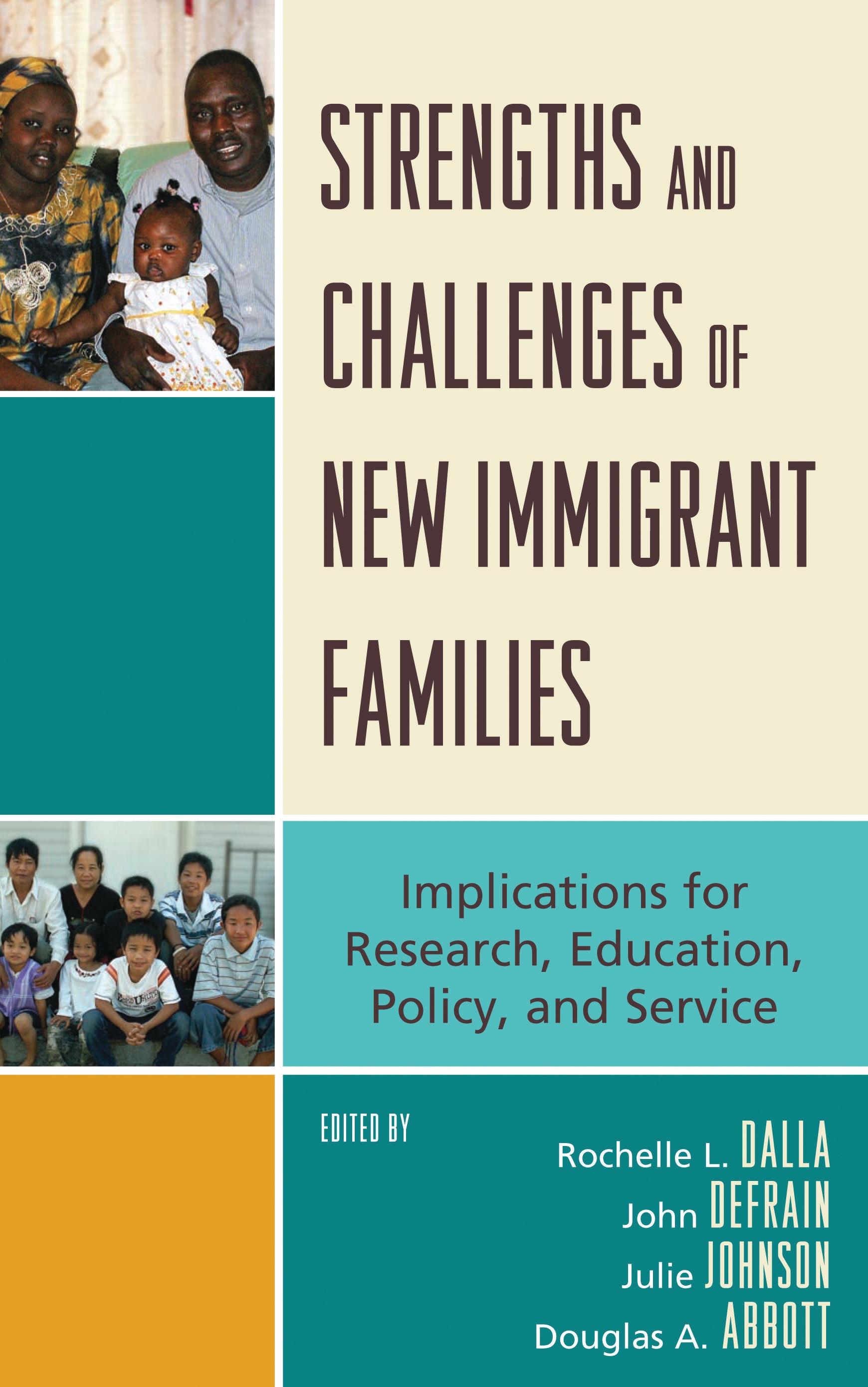
Strengths and Challenges of New Immigrant Families
Author: Richard B. Miller, Yan Xia, Charles B. Hennon, Nancy A. Gonzales, Laura Bates, Christine C. Cook, Julie M. Johnson, Deborah J. Johnson, Sayali S. Amarapurkar, Libby Balter Blume, Amy E. Boren, Laura Thompson Brady, Rodrigo Cantarero, Lee Anne De Reus, Daniel F. Detzner, Steven Garasky, Daiana A. Gonzalez, Kimberly Greder, Pallabi Moulik Gupta, Daniel Hatch, C Richard Hofstetter, M Janice Hogan, Melbourne F. Hovell, Veronica L. Irvin, Kyoung-Rae Jung, George P. Knight, Ryan P. Jacobson, Jooeun Lee, Rucha Londhe, Tom Luster, Ana Martinez-Donate, Leakhena Nou, Hee Young Paik, Pusparandi Panda, Hae Ryun Park, James J. Potter, Wei Qiu, M Elise Radina, Dorit Radnai-Griffin, Bruce C. Randall, Mark W. Roosa, Delia S. Saenz, Gregory F. Sanders, Yoshie Sano, Aysem R. Senyurekli, Khadija S. Sheikh, Archana Singh, Linda Skogrand, Bahira Sherif Trask, Paula M. Usita, Lynet Uttal, Stephan M. Wilson, Xiaolin Xie, Oksana Yakushko, Pa Nhia D. Yang, Joy Zakarian, Rochelle L. Dalla, John Defrain, Douglas A. Abbott
Publisher: Bloomsbury Publishing
Edition: 1
Published date: 2009
ISBN: 9780739114568
Immigration to America is an issue that often sparks intense emotional reactions-from passion and compassion to anger and even rage. Often missing from the dialogue, however, is discussion of the strengths of immigrant newcomers-the abilities and positive characteristics they bring as individuals and families to our country, and how these contribute to the agency, growth, and vitality of America. This book was intended to move the discussion of immigration, generally speaking, and of immigrant families specifically, to include how and in what ways new immigrants to America (those arriving within the past thirty years) have changed the social and geocultural landscape of this country in positive, beneficial, and valuable ways.
The book is comprised of nineteen chapters written by scholars with expertise on immigrant families representing every corner of the globe-from Africa and India to Europe and Central America. In each chapter, the unique factors, processes, and worldviews which help shape and mold the immigrant experience are articulated, as are the strengths immigrant newcomers bring to America. In addition, beyond explicating the strengths of immigrant families, each of the nineteen contributing chapters focuses on the implications of these strengths for families, communities, and the culture. Thus, the book provides a springboard from which to answer the application and "what now" questions for those who work with immigrant families in a variety of capacities-from academicians and researchers to educators and human-service providers.
The book is comprised of nineteen chapters written by scholars with expertise on immigrant families representing every corner of the globe-from Africa and India to Europe and Central America. In each chapter, the unique factors, processes, and worldviews which help shape and mold the immigrant experience are articulated, as are the strengths immigrant newcomers bring to America. In addition, beyond explicating the strengths of immigrant families, each of the nineteen contributing chapters focuses on the implications of these strengths for families, communities, and the culture. Thus, the book provides a springboard from which to answer the application and "what now" questions for those who work with immigrant families in a variety of capacities-from academicians and researchers to educators and human-service providers.
Pay easily by card, Klarna, Apple Pay or Google Pay. Not happy? You always have a 14-day money-back guarantee. Read more in our terms. If you have any questions, email us at hello@memmo.org.
Memmo makes studying easier – wherever you are in the world. We bring your course books and smart study tools together in one place: summaries, quizzes, podcasts and flashcards. Plus Ted, your study buddy who answers anything you wonder. Over 50,000 students already study here – built to help you learn faster and stress less.