
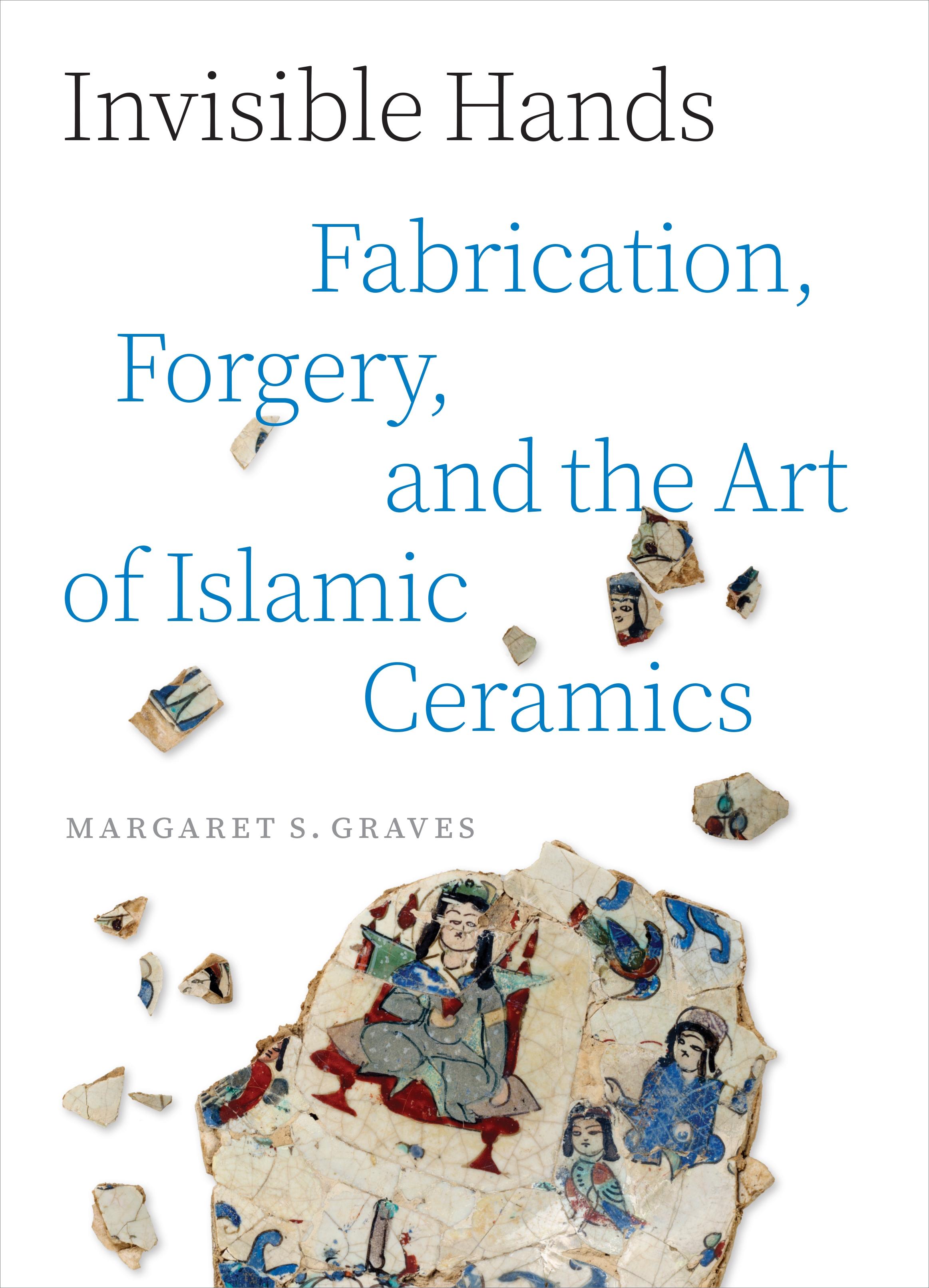
The remarkable history of forged and fabricated Islamic ceramics, their makers, and their unique role in colonial trade
In the heyday of Islamic art collecting around the turn of the twentieth century, thousands of premodern ceramic objects circulated on the international antiquities market. Invisible Hands tells the story of how traditional craft skills of the Islamic world, often thought to have died out with the advent of industrialization, were redirected toward a thriving new market in the colonial era: the fabrication and fictionalizing of antiquities, especially ceramics.
In this stunning work of art history, Margaret Graves shakes the foundations of the discipline, challenging us to reconsider what is and is not art. She traces how sophisticated fabrications—as modern as they were believed to be medieval—moved within an international network of diggers, dealers, and collectors who took advantage of a largely unregulated marketplace to exchange and amass objects that were fabulous in every sense of the word. She looks at canonical artworks as well as many previously unpublished and rarely seen objects, shedding light on the astonishingly varied ways Islamic ceramics were altered and remade by highly skilled craftspeople to meet the demands of Western collectors. Shifting away from the moralizing stance of past studies on reconstructed Islamic ceramics, Graves shows how fabrication and forgery became a major site of participation in modern global capitalism and establishes an entirely new paradigm in the history of art.
Drawing on a substantive new body of provenance research, archaeology, economic history, and laboratory analysis, Invisible Hands centers previously marginalized objects, reframing the practices of fabrication and forgery as crucial forms of invention and artistic skill worthy of study and admiration.
Pay easily by card, Klarna, Apple Pay or Google Pay. Not happy? You always have a 14-day money-back guarantee. Read more in our terms. If you have any questions, email us at hello@memmo.org.
Memmo makes studying easier – wherever you are in the world. We bring your course books and smart study tools together in one place: summaries, quizzes, podcasts and flashcards. Plus Ted, your study buddy who answers anything you wonder. Over 50,000 students already study here – built to help you learn faster and stress less.