
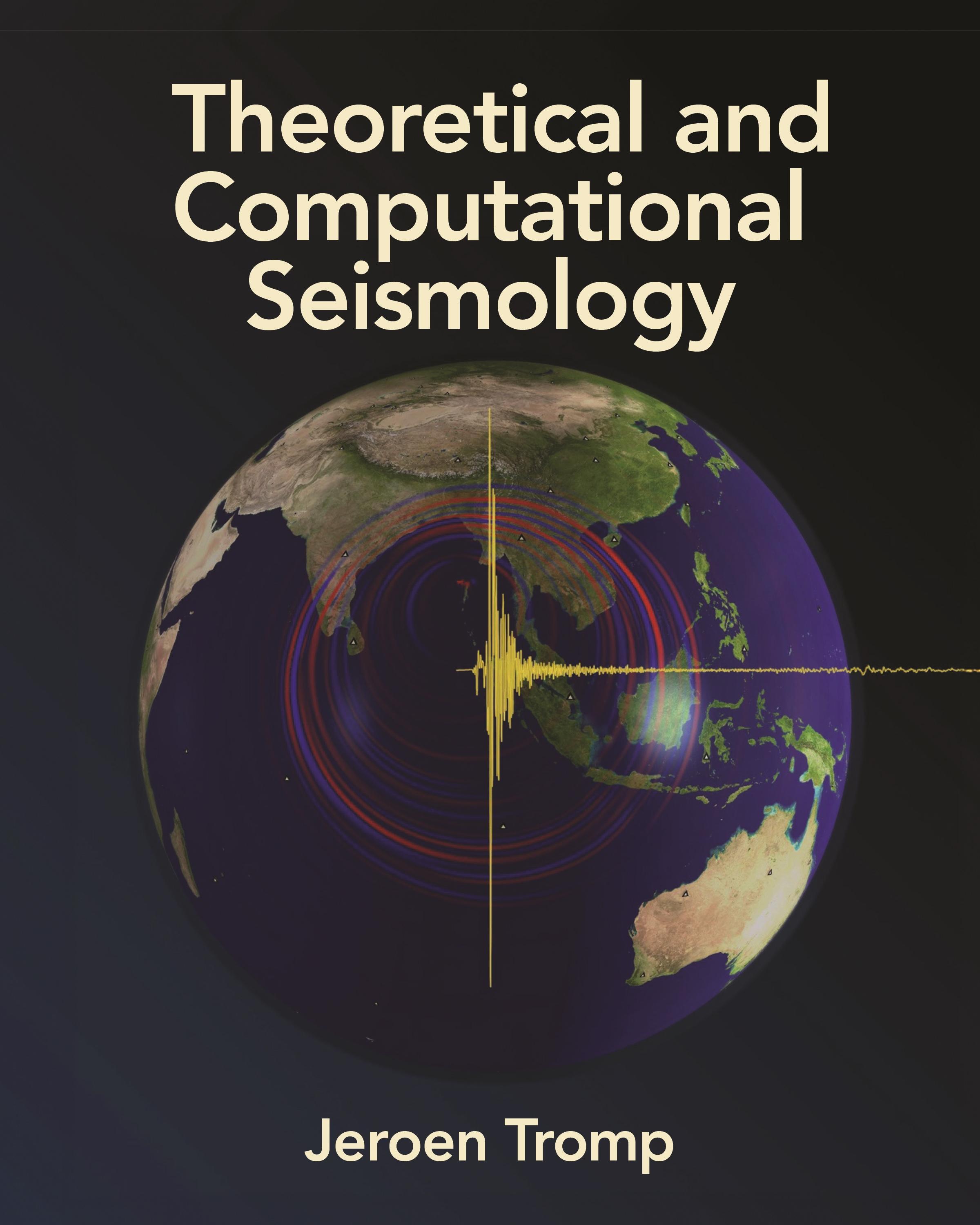
An authoritative, self-contained reference text on theoretical and computational seismology
Over the past several decades, computational advances have revolutionized seismology, making it possible to simulate seismic wave propagation in complex Earth models and create detailed images of the planet’s interior. This cutting-edge text introduces students and scholars to the fundamentals, techniques, and applications of this exciting field of research and discovery.
After establishing a strong foundation in continuum mechanics, the book presents the fundamentals of theoretical seismology, providing a basis for subsequent forward and inverse modeling grounded in numerical methods, and then focuses on computational seismology, investigating numerical solutions to seismic wave equations. The adjoint-state method is covered next, along with applications of this technique to waveform inversions across scales, after which the book concludes with a set of appendixes that provide a primer to differential geometry and tensor calculus, which are used throughout the book to explain the fundamental concepts of deformation, strain, and stress from both Eulerian and Lagrangian perspectives. Including over 150 student-tested exercises, the book is an essential resource for motivated students and scholars seeking to master the state of the art of theoretical and computational seismology.
- Establishes a strong foundation through a geometric analysis of continuum mechanics
- Reveals how linearizing the resulting equations of motion enables the simulation of seismic wave propagation across nine decades of frequencies and wavelengths
- Demonstrates how to leverage the capabilities of simulations to create detailed tomographic images from the information embedded in seismographic recordings
- Covers diverse application areas, including seismology, helioseismology, underwater acoustics, medical imaging, and nondestructive testing
- Features a wealth of exercises (with online solutions)
- Includes a comprehensive set of appendixes on differential geometry and tensor calculus
- An ideal textbook for graduate students studying theoretical seismology, computational seismology, or optimization and inverse problems
- An essential reference for researchers and scholars
Pay easily by card, Klarna, Apple Pay or Google Pay. Not happy? You always have a 14-day money-back guarantee. Read more in our terms. If you have any questions, email us at hello@memmo.org.
Memmo makes studying easier – wherever you are in the world. We bring your course books and smart study tools together in one place: summaries, quizzes, podcasts and flashcards. Plus Ted, your study buddy who answers anything you wonder. Over 50,000 students already study here – built to help you learn faster and stress less.