
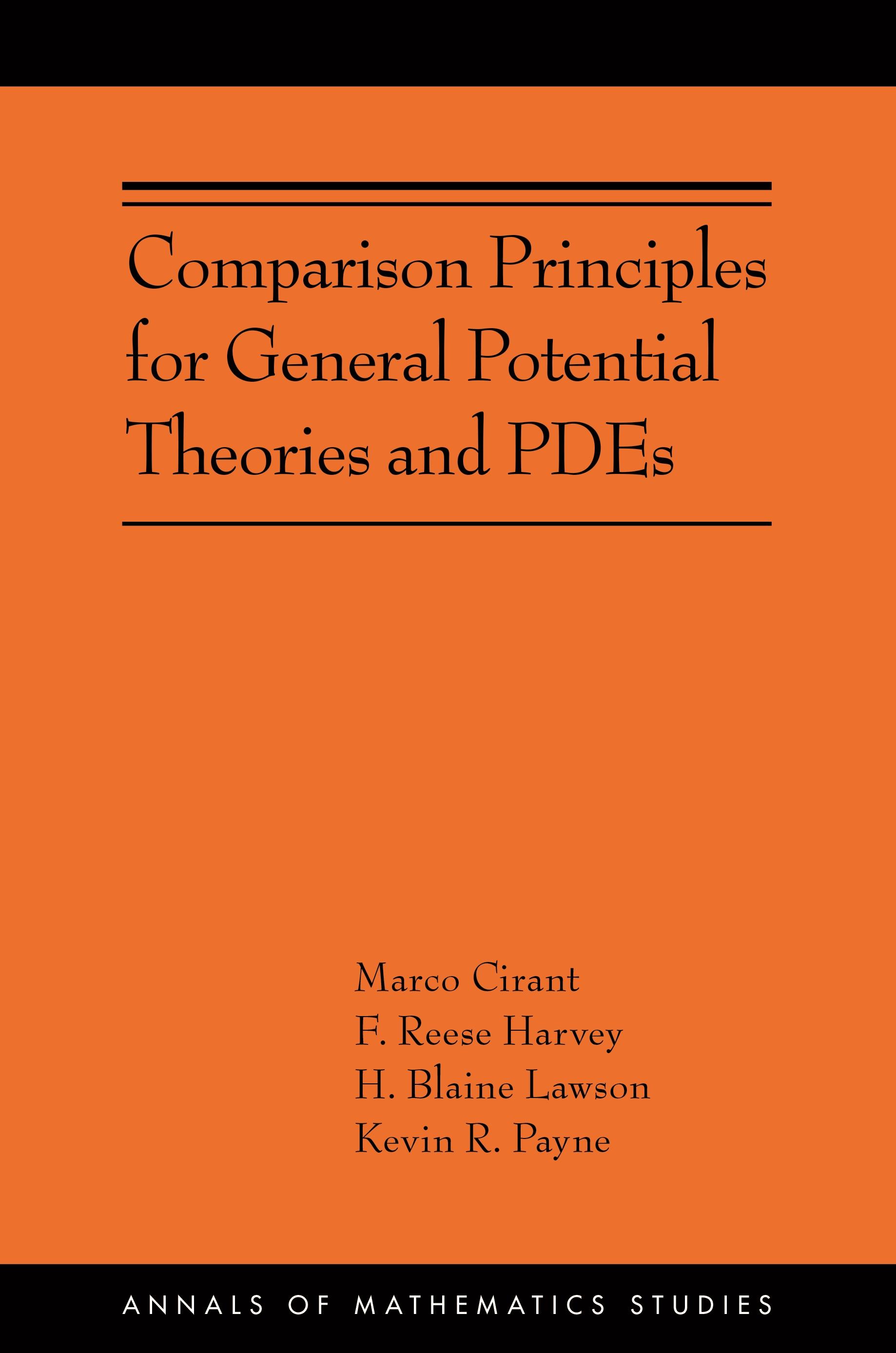
An examination of the symbiotic and productive relationship between fully nonlinear partial differential equations and generalized potential theories
In recent years, there has evolved a symbiotic and productive relationship between fully nonlinear partial differential equations and generalized potential theories. This book examines important aspects of this story. One main purpose is to prove comparison principles for nonlinear potential theories in Euclidian spaces straightforwardly from duality and monotonicity under the weakest possible notion of ellipticity. The book also shows how to deduce comparison principles for nonlinear differential operators, by marrying these two points of view, under the correspondence principle.
The authors explain that comparison principles are fundamental in both contexts, since they imply uniqueness for the Dirichlet problem. When combined with appropriate boundary geometries, yielding suitable barrier functions, they also give existence by Perron’s method. There are many opportunities for cross-fertilization and synergy. In potential theory, one is given a constraint set of 2-jets that determines its subharmonic functions. The constraint set also determines a family of compatible differential operators. Because there are many such operators, potential theory strengthens and simplifies the operator theory. Conversely, the set of operators associated with the constraint can influence the potential theory.
Pay easily by card, Klarna, Apple Pay or Google Pay. Not happy? You always have a 14-day money-back guarantee. Read more in our terms. If you have any questions, email us at hello@memmo.org.
Memmo makes studying easier – wherever you are in the world. We bring your course books and smart study tools together in one place: summaries, quizzes, podcasts and flashcards. Plus Ted, your study buddy who answers anything you wonder. Over 75,000 students already study here – built to help you learn faster and stress less.