
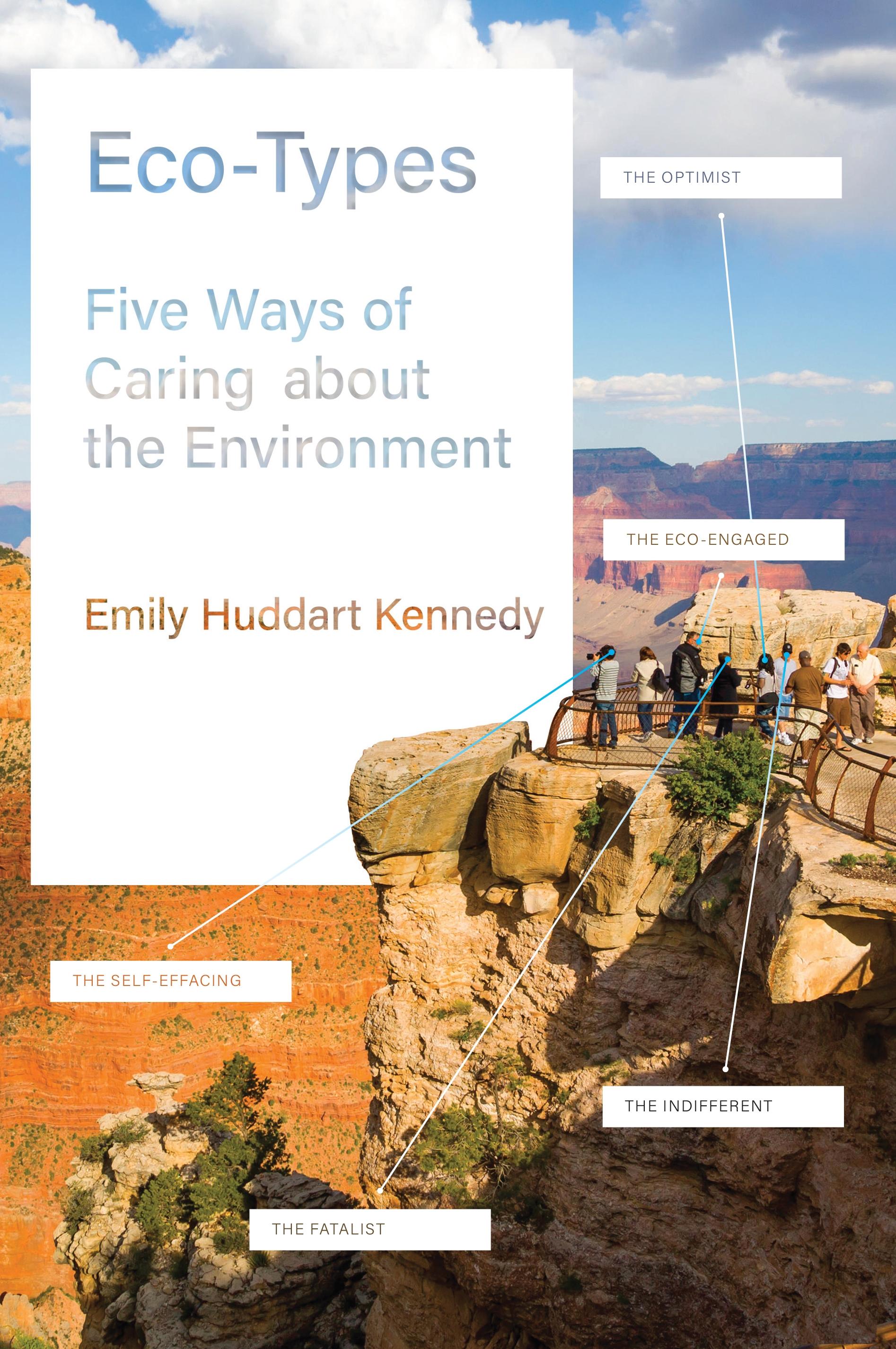
Why acknowledging diverse eco-social relationships can help us overcome the political polarization that undermines our ability to protect the environment
When we picture the ideal environmentalist, we likely have in mind someone who dedicates herself to reducing her own environmental footprint through individual choices about consumption—driving a fuel-efficient car, for example, or eating less meat, or refusing plastic straws. This is a benchmark that many aspire to—and many others reject. In Eco-Types, Emily Huddart Kennedy shows that there is more than one way to care about the environment, outlining a spectrum of eco-social relationships that range from engagement to indifference.
Drawing on three years of interviews and research, Kennedy describes five archetypal relationships with the environment: the Eco-Engaged, often politically liberal, who have an acute level of concern about the environment, a moral commitment to protect it, and the conviction that an individual can make a difference; the Self-Effacing, who share the Eco-Engaged’s concerns but not the belief in their own efficacy; the Optimists, often politically conservative, who are confident in their relationship with the environment, doubt the severity of environmental problems, and resent insinuations that they don’t care; the Fatalists, who are pessimistic about environmental decline and feel little responsibility to adopt environment-friendly habits; and the Indifferent, who have no affinity for any part of the environmental movement.
Kennedy argues that when liberals feel they have a moral monopoly on environmental issues, polarization results. If we are serious about protecting the planet, we must acknowledge that we don’t all need to care about the environment in the same way.
Pay easily by card, Klarna, Apple Pay or Google Pay. Not happy? You always have a 14-day money-back guarantee. Read more in our terms. If you have any questions, email us at hello@memmo.org.
Memmo makes studying easier – wherever you are in the world. We bring your course books and smart study tools together in one place: summaries, quizzes, podcasts and flashcards. Plus Ted, your study buddy who answers anything you wonder. Over 50,000 students already study here – built to help you learn faster and stress less.