
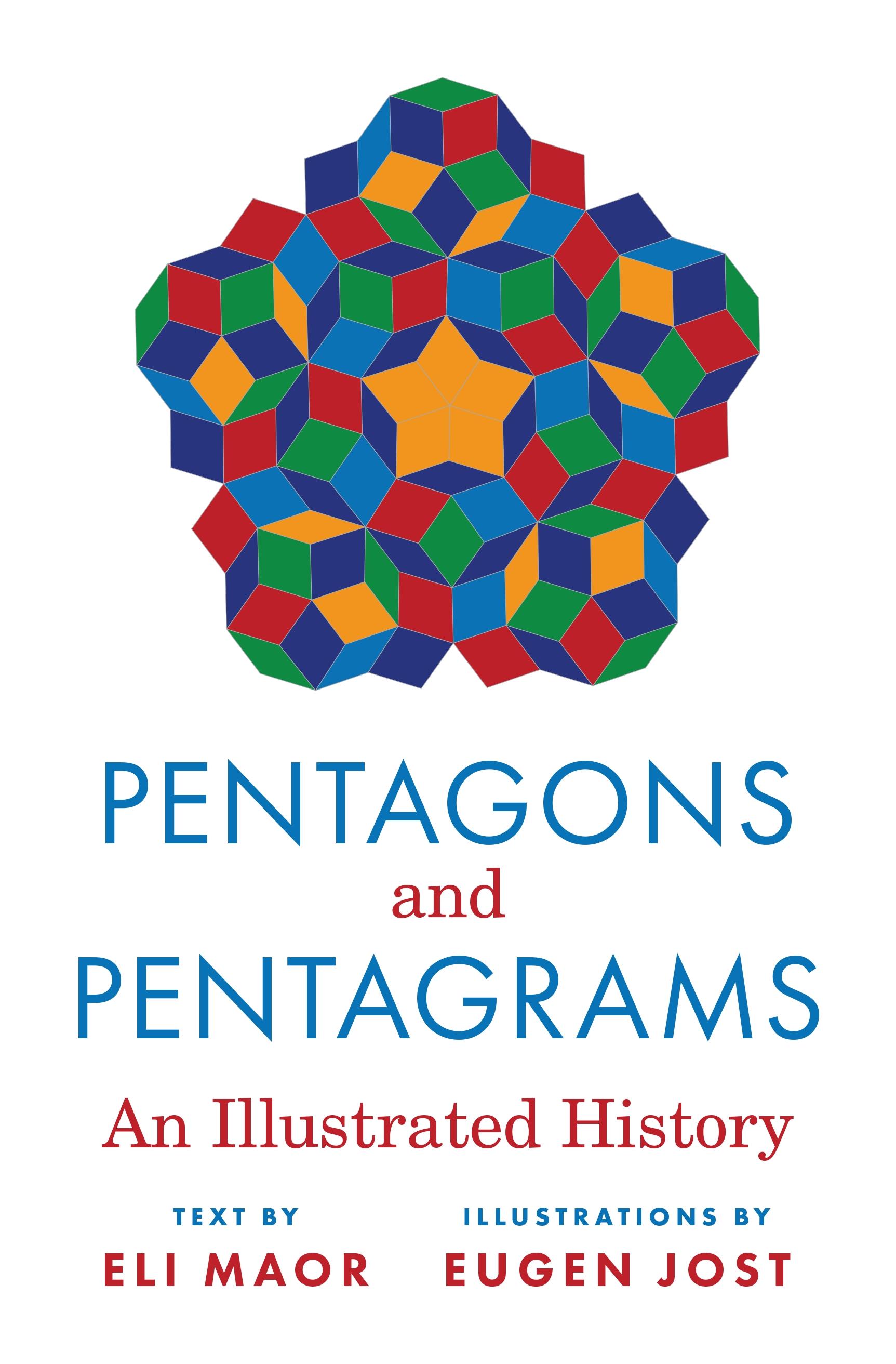
A fascinating exploration of the pentagon and its role in various cultures
The pentagon and its close cousin, the pentagram, have inspired individuals for the last two and half millennia, from mathematicians and philosophers to artists and naturalists. Despite the pentagon’s wide-ranging history, no single book has explored the important role of this shape in various cultures, until now. Richly illustrated, Pentagons and Pentagrams offers a sweeping view of the five-sided polygon, revealing its intriguing geometric properties and its essential influence on a variety of fields.
Traversing time, Eli Maor narrates vivid stories, both celebrated and unknown, about the pentagon and pentagram. He discusses the early Pythagoreans, who ascribed to the pentagon mythical attributes, adopted it as their emblem, and figured out its construction with a straightedge and compass. Maor looks at how a San Diego housewife uncovered four previously unknown types of pentagonal tilings, and how in 1982 a scientist’s discovery of fivefold symmetries in certain alloys caused an uproar in crystallography and led to a Nobel Prize. Maor also discusses the pentagon’s impact on many buildings, from medieval fortresses to the Pentagon in Washington, D.C. Eugen Jost’s superb illustrations provide sumptuous visual context, and the book’s puzzles and mazes offer fun challenges for readers, with solutions given in an appendix.
Pay easily by card, Klarna, Apple Pay or Google Pay. Not happy? You always have a 14-day money-back guarantee. Read more in our terms. If you have any questions, email us at hello@memmo.org.
Memmo makes studying easier – wherever you are in the world. We bring your course books and smart study tools together in one place: summaries, quizzes, podcasts and flashcards. Plus Ted, your study buddy who answers anything you wonder. Over 75,000 students already study here – built to help you learn faster and stress less.