
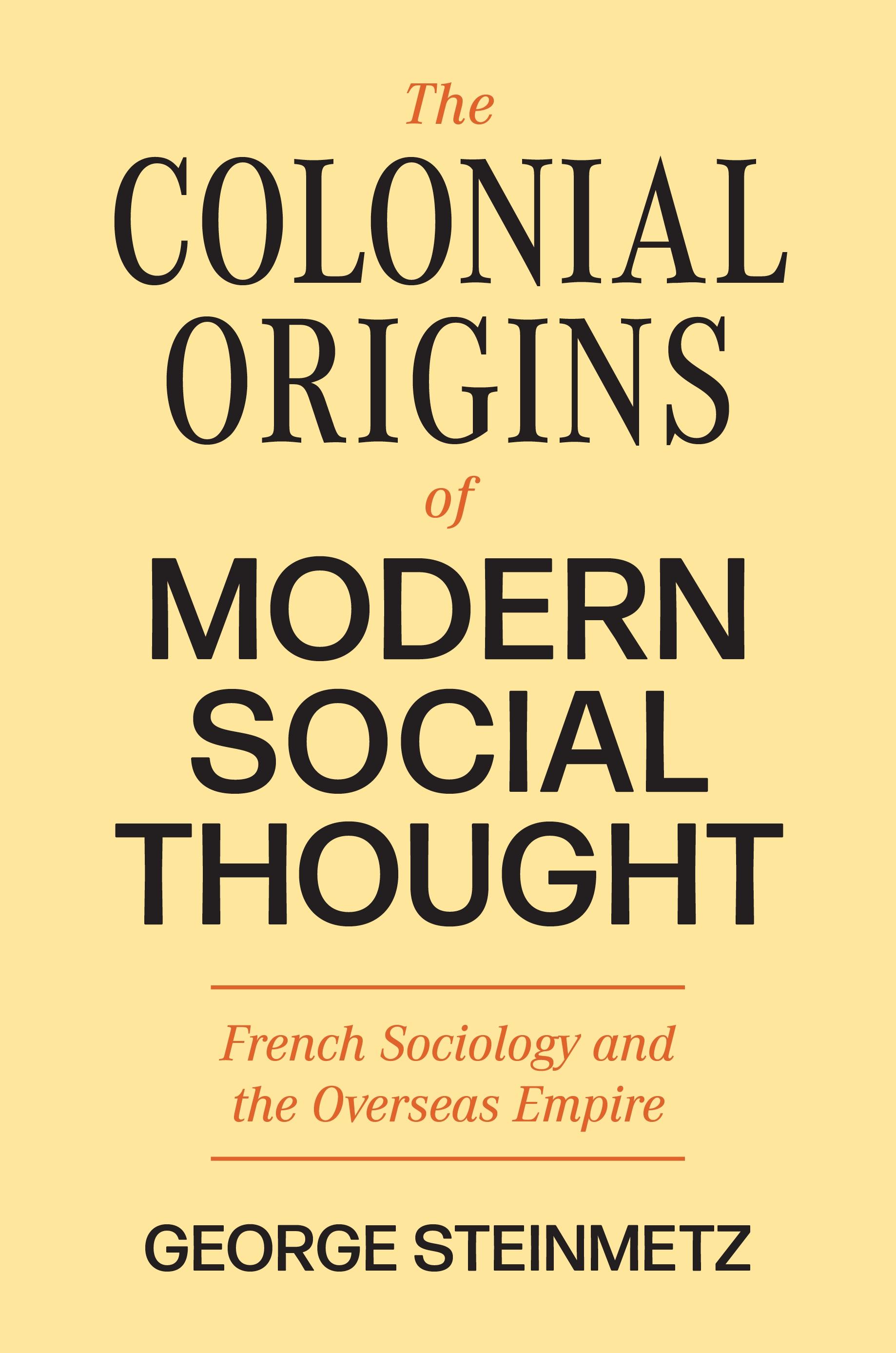
A new history of French social thought that connects postwar sociology to colonialism and empire
In this provocative and original retelling of the history of French social thought, George Steinmetz places the history and development of modern French sociology in the context of the French empire after World War II. Connecting the rise of all the social sciences with efforts by France and other imperial powers to consolidate control over their crisis-ridden colonies, Steinmetz argues that colonial research represented a crucial core of the renascent academic discipline of sociology, especially between the late 1930s and the 1960s. Sociologists, who became favored partners of colonial governments, were asked to apply their expertise to such “social problems” as detribalization, urbanization, poverty, and labor migration. This colonial orientation permeated all the major subfields of sociological research, Steinmetz contends, and is at the center of the work of four influential scholars: Raymond Aron, Jacques Berque, Georges Balandier, and Pierre Bourdieu.
In retelling this history, Steinmetz develops and deploys a new methodological approach that combines attention to broadly contextual factors, dynamics within the intellectual development of the social sciences and sociology in particular, and close readings of sociological texts. He moves gradually toward the postwar sociologists of colonialism and their writings, beginning with the most macroscopic contexts, which included the postwar “reoccupation” of the French empire and the turn to developmentalist policies and the resulting demand for new forms of social scientific expertise. After exploring the colonial engagement of researchers in sociology and neighboring fields before and after 1945, he turns to detailed examinations of the work of Aron, who created a sociology of empires; Berque, the leading historical sociologist of North Africa; Balandier, the founder of French Africanist sociology; and Bourdieu, whose renowned theoretical concepts were forged in war-torn, late-colonial Algeria.
Pay easily by card, Klarna, Apple Pay or Google Pay. Not happy? You always have a 14-day money-back guarantee. Read more in our terms. If you have any questions, email us at hello@memmo.org.
Memmo makes studying easier – wherever you are in the world. We bring your course books and smart study tools together in one place: summaries, quizzes, podcasts and flashcards. Plus Ted, your study buddy who answers anything you wonder. Over 50,000 students already study here – built to help you learn faster and stress less.