
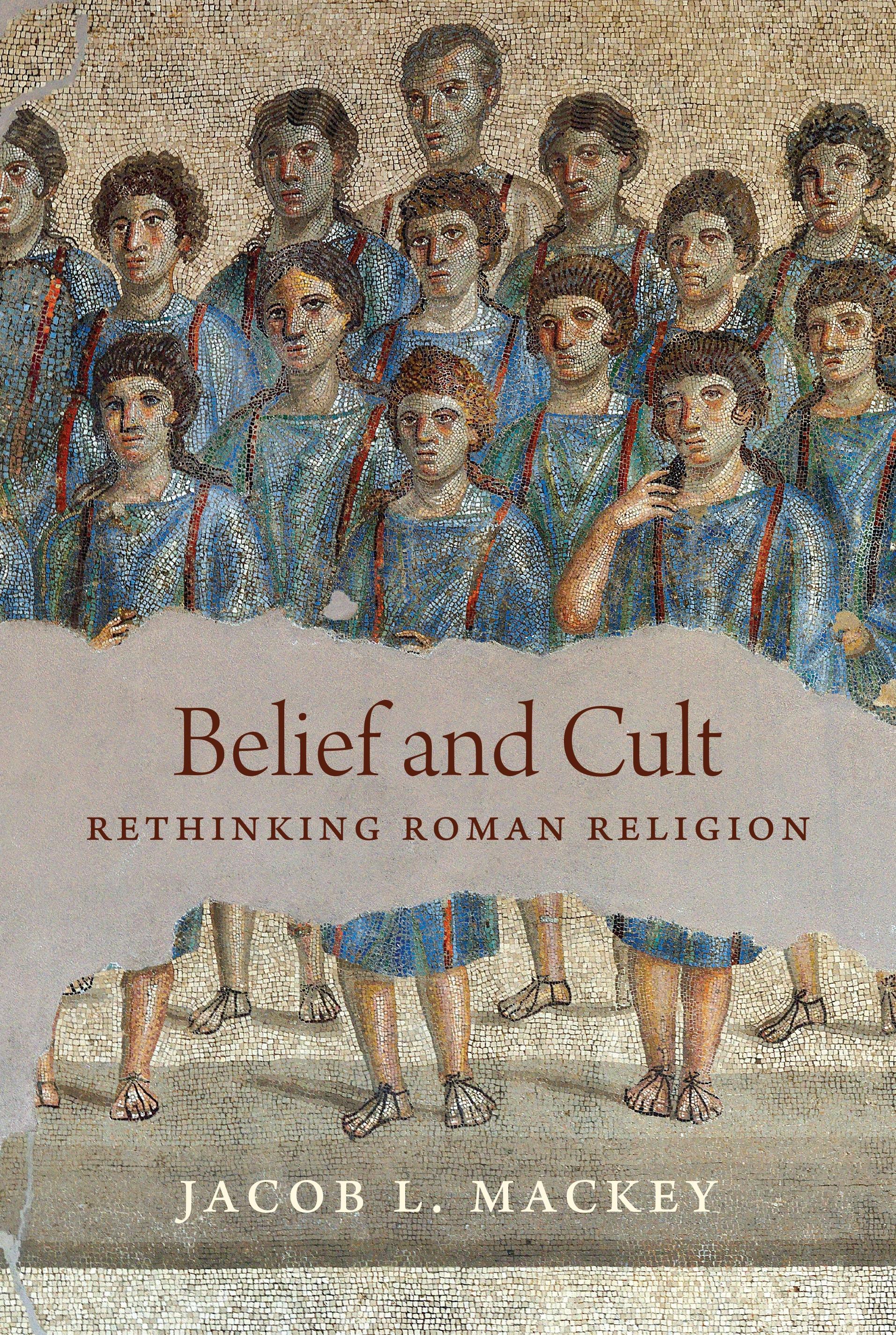
A groundbreaking reinterpretation that draws on cognitive theory to show that belief wasn’t absent from—but rather was at the heart of—Roman religion
Belief and Cult argues that belief isn’t uniquely Christian but was central to ancient Roman religion. Drawing on cognitive theory, Jacob Mackey shows that despite having nothing to do with salvation or faith, belief underlay every aspect of Roman religious practices—emotions, individual and collective cult action, ritual norms, social reality, and social power. In doing so, he also offers a thorough argument for the importance of belief to other non-Christian religions.
At the individual level, the book argues, belief played an indispensable role in the genesis of cult action and religious emotion. However, belief also had a collective dimension. The cognitive theory of Shared Intentionality shows how beliefs may be shared among individuals, accounting for the existence of written, unwritten, or even unspoken ritual norms. Shared beliefs permitted the choreography of collective cult action and gave cult acts their social meanings. The book also elucidates the role of shared belief in creating and maintaining Roman social reality. Shared belief allowed the Romans to endow agents, actions, and artifacts with socio-religious status and power. In a deep sense, no man could count as an augur and no act of animal slaughter as a successful offering to the gods, unless Romans collectively shared appropriate beliefs about these things.
Closely examining augury, prayer, the religious enculturation of children, and the Romans’ own theories of cognition and cult, Belief and Cult promises to revolutionize the understanding of Roman religion by demonstrating that none of its features makes sense without Roman belief.
Pay easily by card, Klarna, Apple Pay or Google Pay. Not happy? You always have a 14-day money-back guarantee. Read more in our terms. If you have any questions, email us at hello@memmo.org.
Memmo makes studying easier – wherever you are in the world. We bring your course books and smart study tools together in one place: summaries, quizzes, podcasts and flashcards. Plus Ted, your study buddy who answers anything you wonder. Over 75,000 students already study here – built to help you learn faster and stress less.