
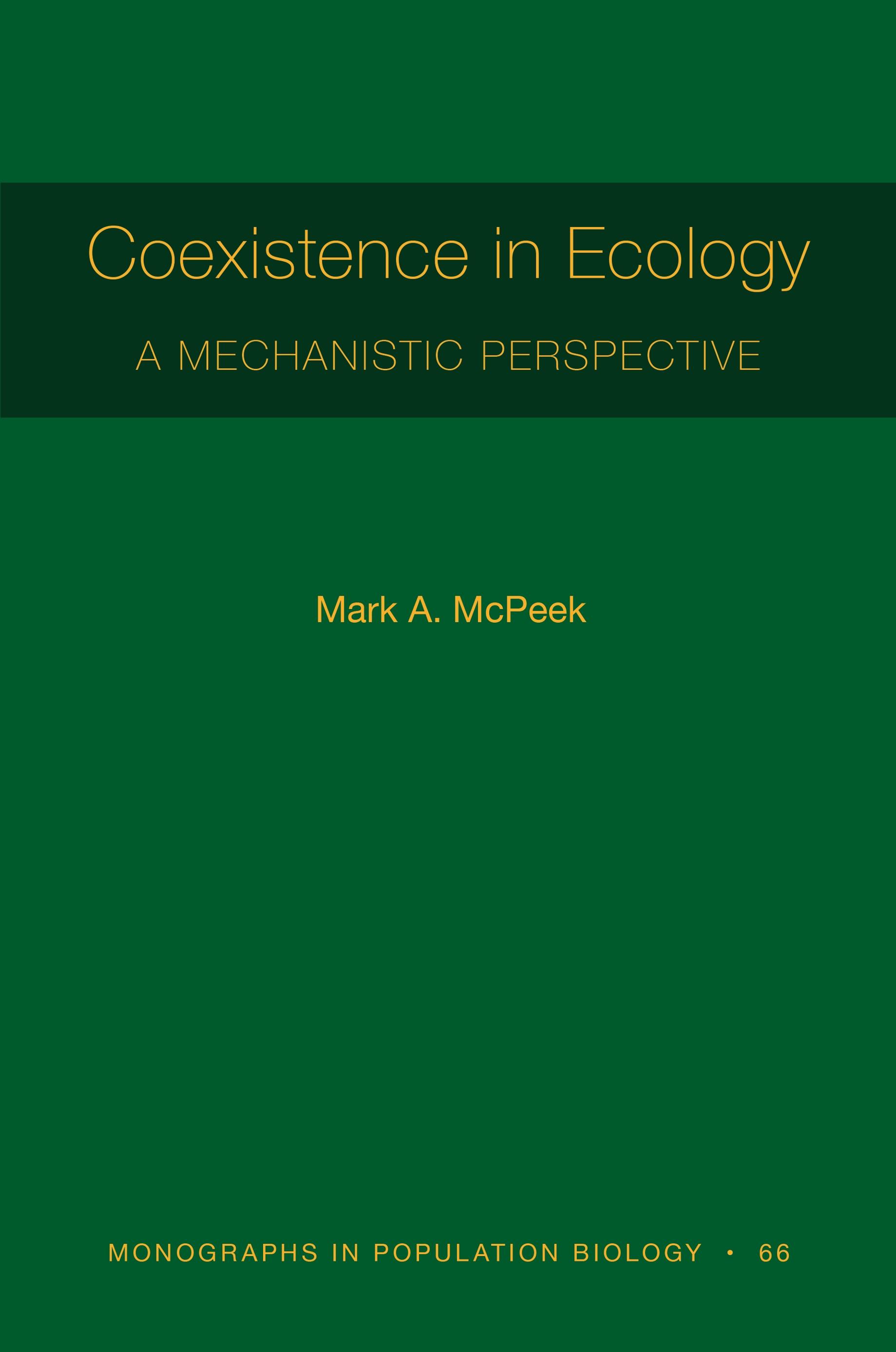
A comprehensive framework for understanding species coexistence
Coexistence is the central concept in community ecology, but an understanding of this concept requires that we study the actual mechanisms of species interactions. Coexistence in Ecology examines the major features of these mechanisms for species that coexist at different positions in complex food webs, and derives empirical tests from model predictions.
Exploring the various challenges species face, Mark McPeek systematically builds a model food web, beginning with an ecosystem devoid of life and then adding one species at a time. With the introduction of each new species, he evaluates the properties it must possess to invade a community and quantifies the changes in the abundances of other species that result from a successful invasion. McPeek continues this process until he achieves a multitrophic level food web with many species coexisting at each trophic level, from omnivores, mutualists, and pathogens to herbivores, carnivores, and basic plants. He then describes the observational and experimental empirical studies that can test the theoretical predictions resulting from the model analyses.
Synthesizing decades of theoretical research in community ecology, Coexistence in Ecology offers new perspectives on how to develop an empirical program of study rooted in the natural histories of species and the mechanisms by which they actually interact with one another.
Pay easily by card, Klarna, Apple Pay or Google Pay. Not happy? You always have a 14-day money-back guarantee. Read more in our terms. If you have any questions, email us at hello@memmo.org.
Memmo makes studying easier – wherever you are in the world. We bring your course books and smart study tools together in one place: summaries, quizzes, podcasts and flashcards. Plus Ted, your study buddy who answers anything you wonder. Over 50,000 students already study here – built to help you learn faster and stress less.