
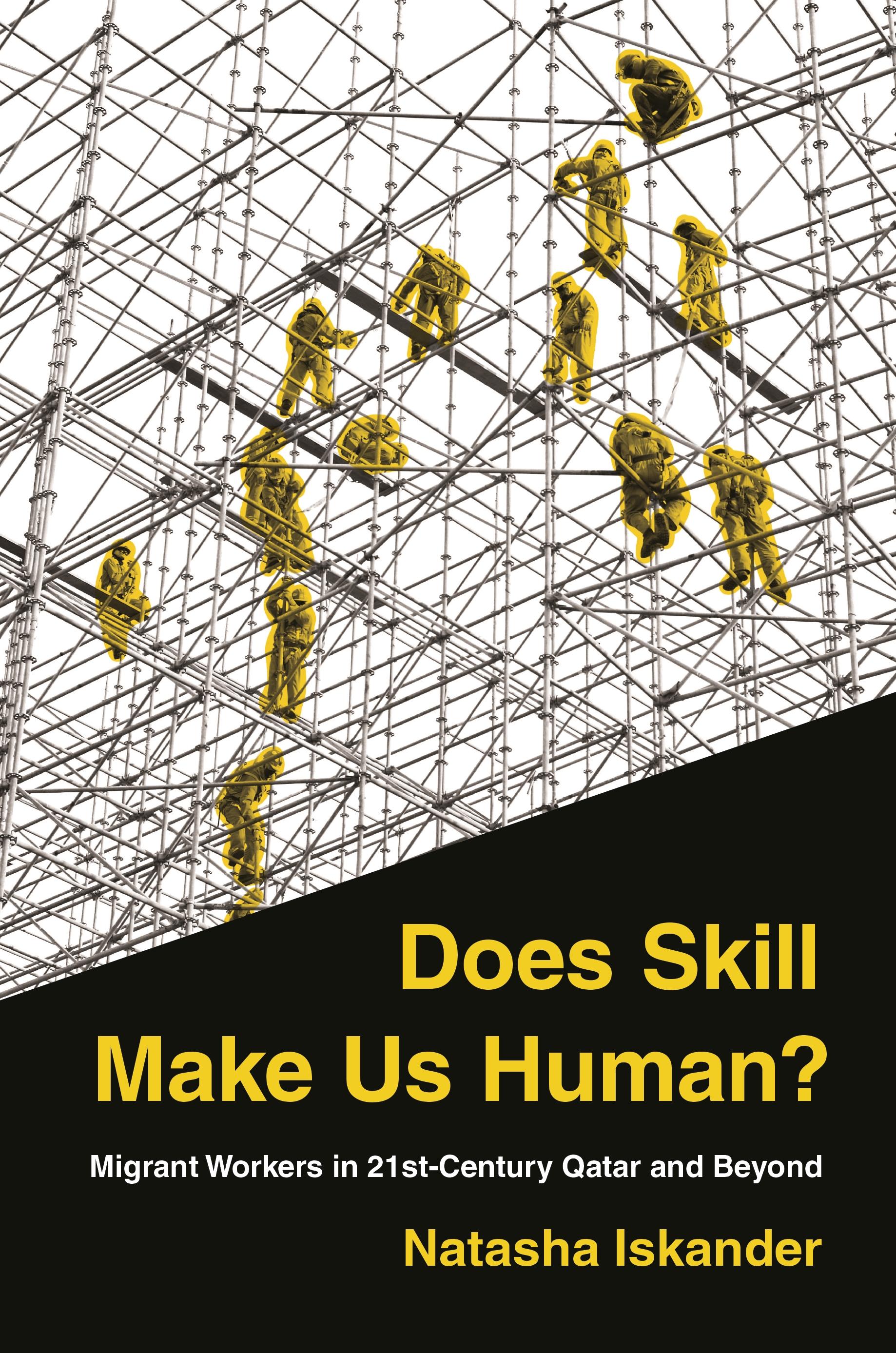
An in-depth look at Qatar's migrant workers and the place of skill in the language of control and power
Skill—specifically the distinction between the “skilled” and “unskilled”—is generally defined as a measure of ability and training, but Does Skill Make Us Human? shows instead that skill distinctions are used to limit freedom, narrow political rights, and even deny access to imagination and desire. Natasha Iskander takes readers into Qatar’s booming construction industry in the lead-up to the 2022 World Cup, and through her unprecedented look at the experiences of migrant workers, she reveals that skill functions as a marker of social difference powerful enough to structure all aspects of social and economic life.
Through unique access to construction sites in Doha, in-depth research, and interviews, Iskander explores how migrants are recruited, trained, and used. Despite their acquisition of advanced technical skills, workers are commonly described as unskilled and disparaged as “unproductive,” “poor quality,” or simply “bodies.” She demonstrates that skill categories adjudicate personhood, creating hierarchies that shape working conditions, labor recruitment, migration policy, the design of urban spaces, and the reach of global industries. Iskander also discusses how skill distinctions define industry responses to global warming, with employers recruiting migrants from climate-damaged places at lower wages and exposing these workers to Qatar’s extreme heat. She considers how the dehumanizing politics of skill might be undone through tactical solidarity and creative practices.
With implications for immigrant rights and migrant working conditions throughout the world, Does Skill Make Us Human? examines the factors that justify and amplify inequality.
Pay easily by card, Klarna, Apple Pay or Google Pay. Not happy? You always have a 14-day money-back guarantee. Read more in our terms. If you have any questions, email us at hello@memmo.org.
Memmo makes studying easier – wherever you are in the world. We bring your course books and smart study tools together in one place: summaries, quizzes, podcasts and flashcards. Plus Ted, your study buddy who answers anything you wonder. Over 50,000 students already study here – built to help you learn faster and stress less.