
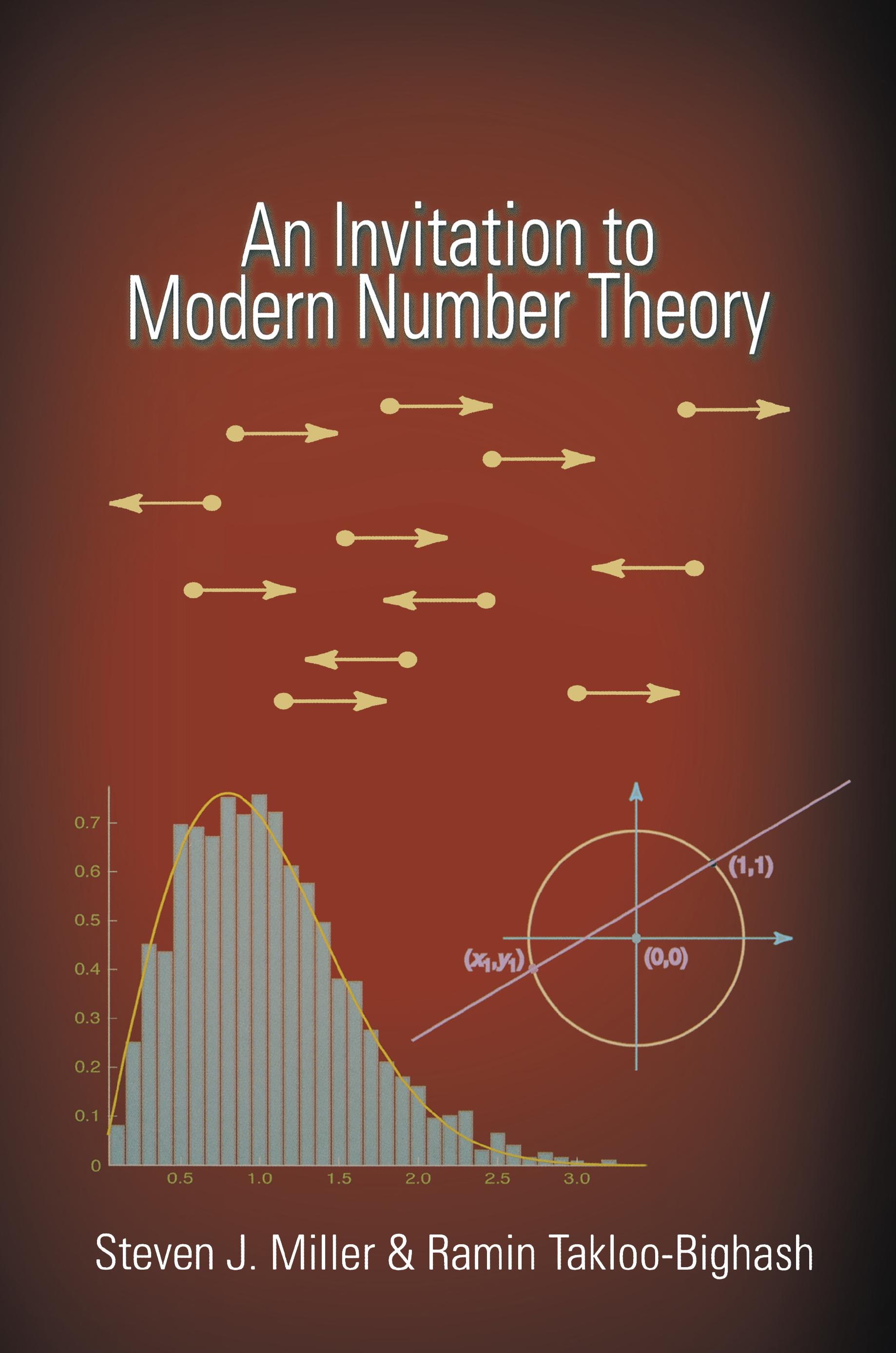
In a manner accessible to beginning undergraduates, An Invitation to Modern Number Theory introduces many of the central problems, conjectures, results, and techniques of the field, such as the Riemann Hypothesis, Roth's Theorem, the Circle Method, and Random Matrix Theory. Showing how experiments are used to test conjectures and prove theorems, the book allows students to do original work on such problems, often using little more than calculus (though there are numerous remarks for those with deeper backgrounds). It shows students what number theory theorems are used for and what led to them and suggests problems for further research.
Steven Miller and Ramin Takloo-Bighash introduce the problems and the computational skills required to numerically investigate them, providing background material (from probability to statistics to Fourier analysis) whenever necessary. They guide students through a variety of problems, ranging from basic number theory, cryptography, and Goldbach's Problem, to the algebraic structures of numbers and continued fractions, showing connections between these subjects and encouraging students to study them further. In addition, this is the first undergraduate book to explore Random Matrix Theory, which has recently become a powerful tool for predicting answers in number theory.
Providing exercises, references to the background literature, and Web links to previous student research projects, An Invitation to Modern Number Theory can be used to teach a research seminar or a lecture class.
Pay easily by card, Klarna, Apple Pay or Google Pay. Not happy? You always have a 14-day money-back guarantee. Read more in our terms. If you have any questions, email us at hello@memmo.org.
Memmo makes studying easier – wherever you are in the world. We bring your course books and smart study tools together in one place: summaries, quizzes, podcasts and flashcards. Plus Ted, your study buddy who answers anything you wonder. Over 75,000 students already study here – built to help you learn faster and stress less.