
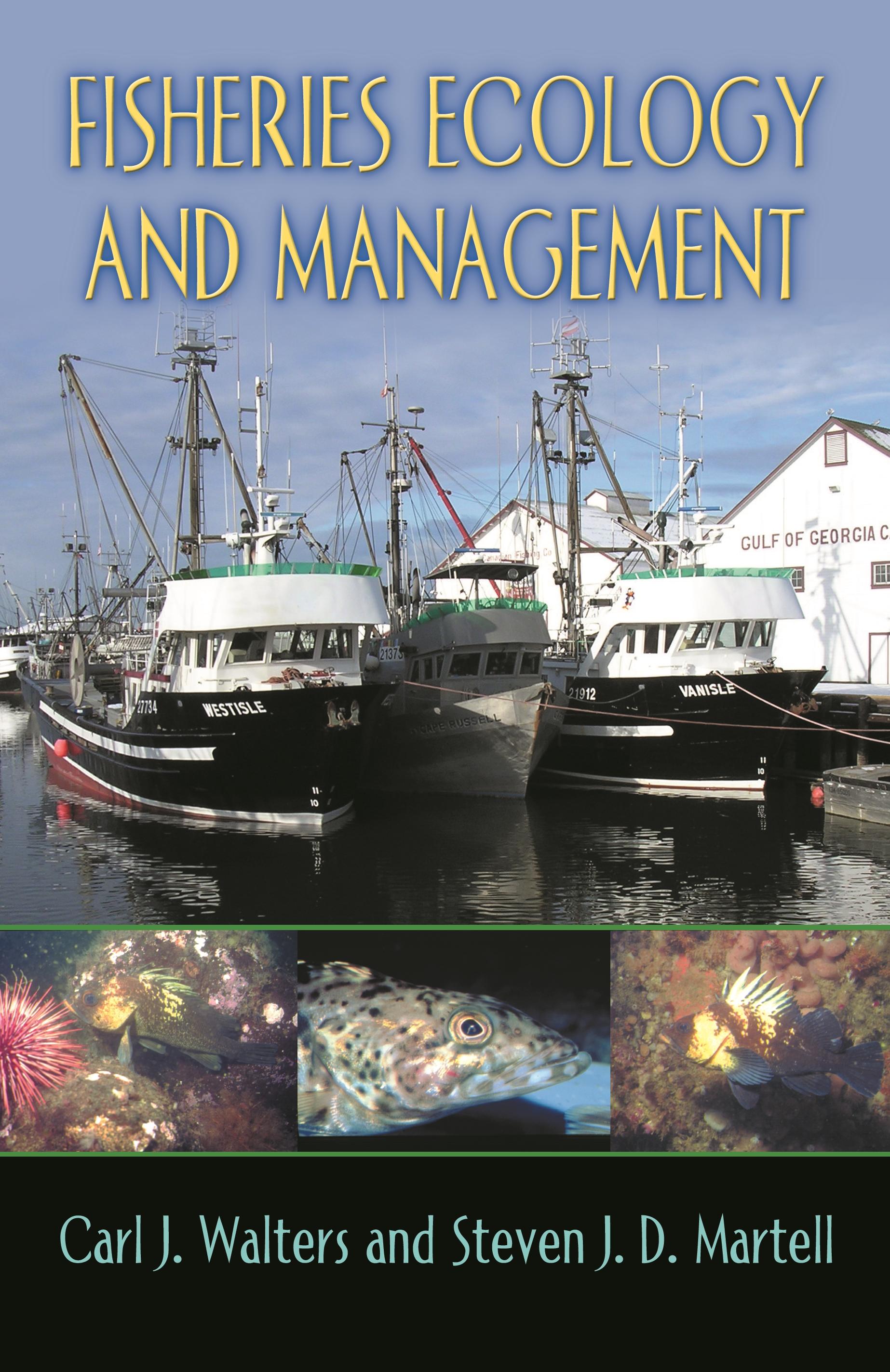
Quantitative modeling methods have become a central tool in the management of harvested fish populations. This book examines how these modeling methods work, why they sometimes fail, and how they might be improved by incorporating larger ecological interactions. Fisheries Ecology and Management provides a broad introduction to the concepts and quantitative models needed to successfully manage fisheries.
Walters and Martell develop models that account for key ecological dynamics such as trophic interactions, food webs, multi-species dynamics, risk-avoidance behavior, habitat selection and density-dependence. They treat fisheries policy development as a two-stage process, first identifying strategies for varying harvest in relation to changes in abundance, then finding ways to implement such strategies in terms of monitoring and regulatory procedures. This book provides a general framework for developing assessment models in terms of state-observation dynamics hypotheses, and points out that most fisheries assessment failures have been due to inappropriate observation model hypotheses rather than faulty models for ecological dynamics.
Intended as a text in upper division and graduate classes on fisheries assessment and management, this useful guide will also be widely read by ecologists and fisheries scientists.
Pay easily by card, Klarna, Apple Pay or Google Pay. Not happy? You always have a 14-day money-back guarantee. Read more in our terms. If you have any questions, email us at hello@memmo.org.
Memmo makes studying easier – wherever you are in the world. We bring your course books and smart study tools together in one place: summaries, quizzes, podcasts and flashcards. Plus Ted, your study buddy who answers anything you wonder. Over 50,000 students already study here – built to help you learn faster and stress less.