
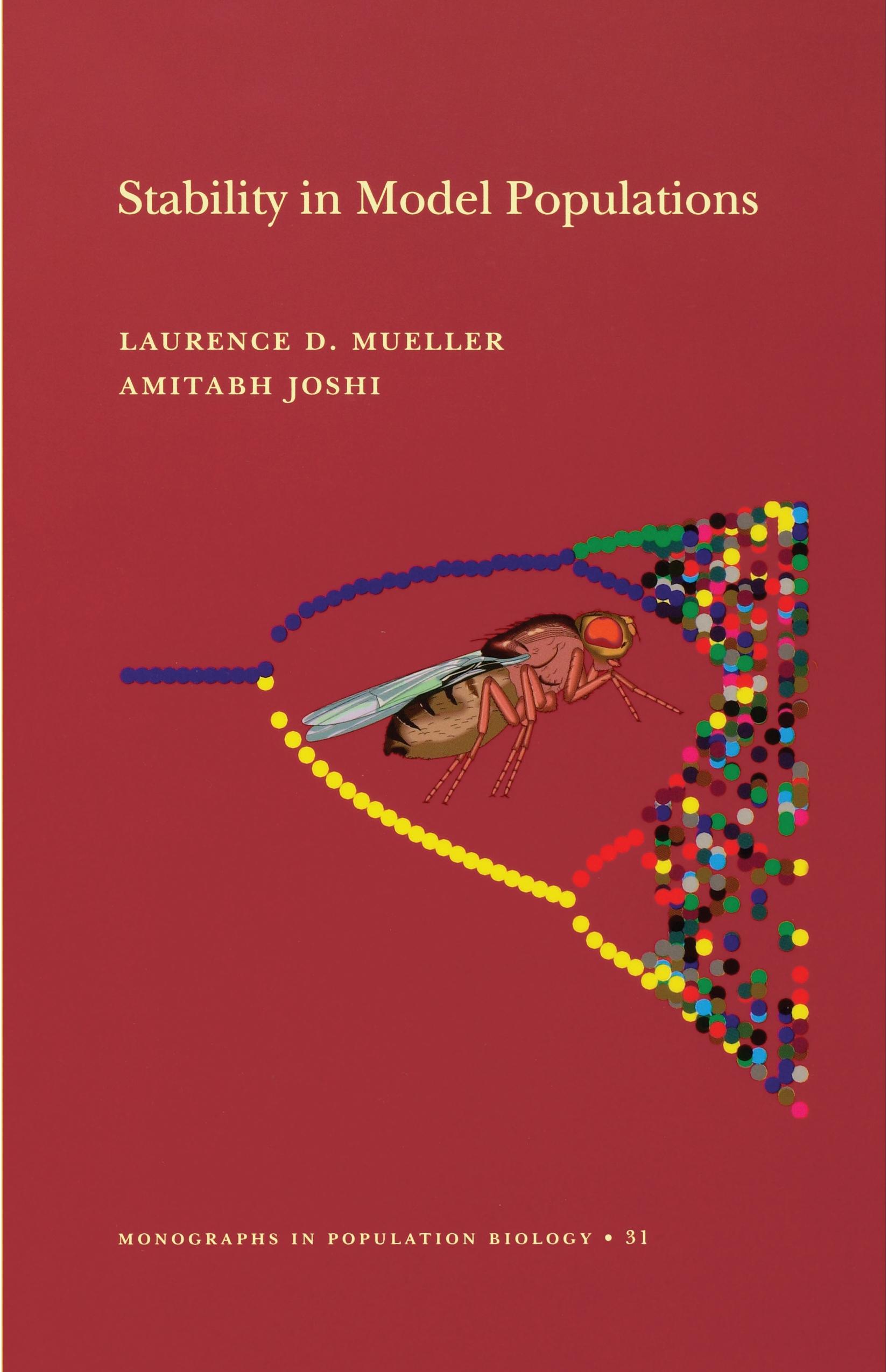
Throughout the twentieth century, biologists investigated the mechanisms that stabilize biological populations, populations which--if unchecked by such agencies as competition and predation--should grow geometrically. How is order in nature maintained in the face of the seemingly disorderly struggle for existence? In this book, Laurence Mueller and Amitabh Joshi examine current theories of population stability and show how recent laboratory research on model populations--particularly blowflies, Tribolium, and Drosophila--contributes to our understanding of population dynamics and the evolution of stability.
The authors review the general theory of population stability and critically analyze techniques for inferring whether a given population is in balance or not. They then show how rigorous empirical research can reveal both the proximal causes of stability (how populations are regulated and maintained at an equilibrium, including the relative roles of biotic and abiotic factors) and its ultimate, mostly evolutionary causes. In the process, they describe experimental studies on model systems that address the effects of age-structure, inbreeding, resource levels, and population structure on the stability and persistence of populations. The discussion incorporates the authors' own findings on the evolution of population stability in Drosophila. They go on to relate laboratory work to studies of animals in the wild and to develop a general framework for relating the life history and ecology of a species to its population dynamics.
This accessible, finely written illustration of how carefully designed experiments can improve theory will have tremendous value for all ecologists and evolutionary biologists.
Pay easily by card, Klarna, Apple Pay or Google Pay. Not happy? You always have a 14-day money-back guarantee. Read more in our terms. If you have any questions, email us at hello@memmo.org.
Memmo makes studying easier – wherever you are in the world. We bring your course books and smart study tools together in one place: summaries, quizzes, podcasts and flashcards. Plus Ted, your study buddy who answers anything you wonder. Over 50,000 students already study here – built to help you learn faster and stress less.