
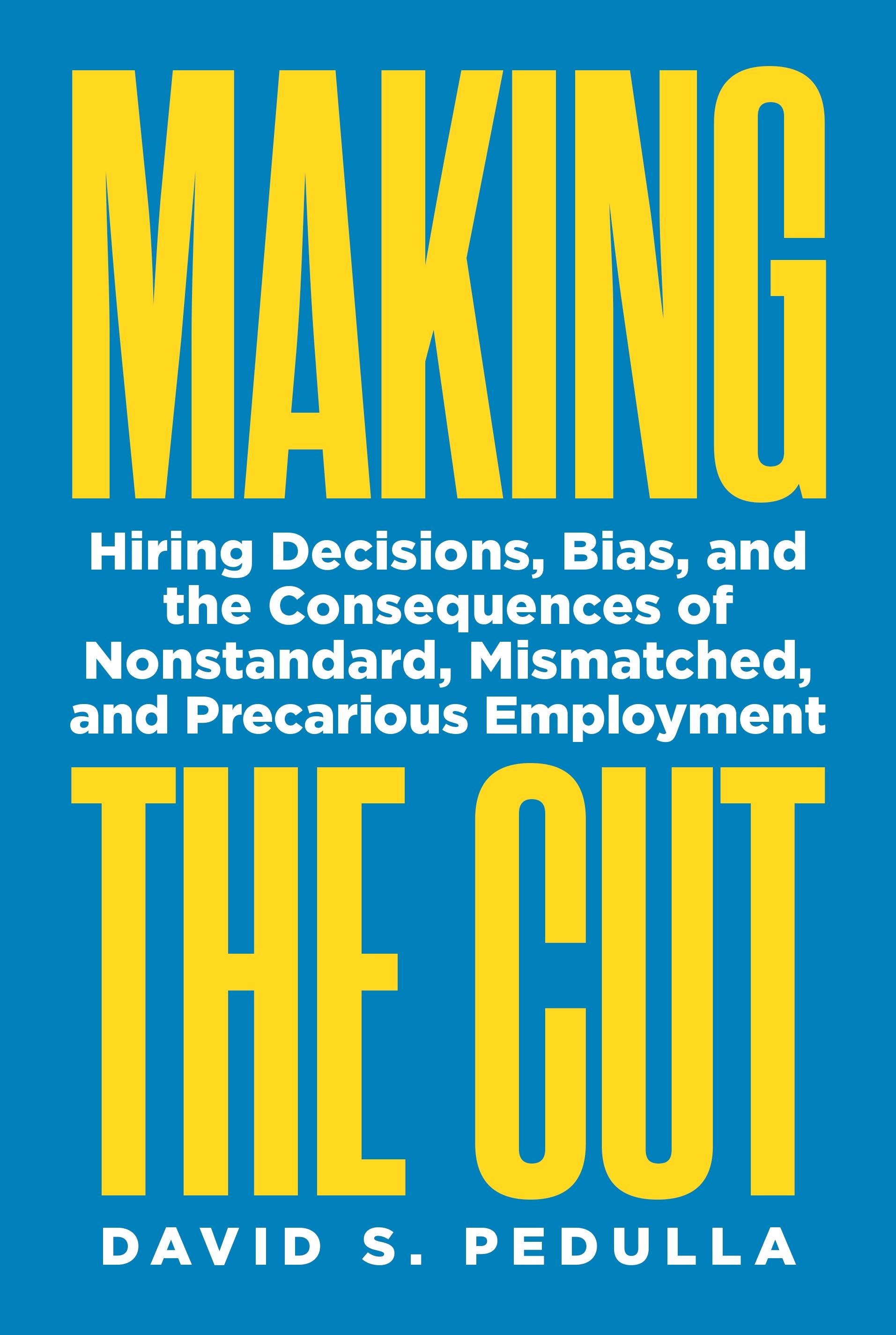
An in-depth look at how employers today perceive and evaluate job applicants with nonstandard or precarious employment histories
Millions of workers today labor in nontraditional situations involving part-time work, temporary agency employment, and skills underutilization or face the precariousness of long-term unemployment. To date, research has largely focused on how these experiences shape workers’ well-being, rather than how hiring agents perceive and treat job applicants who have moved through these positions. Shifting the focus from workers to hiring agents, Making the Cut explores how key gatekeepers—HR managers, recruiters, and talent acquisition specialists—evaluate workers with nonstandard, mismatched, or precarious employment experience. Factoring in the social groups to which workers belong—such as their race and gender—David Pedulla shows how workers get jobs, how the hiring process unfolds, who makes the cut, and who does not.
Drawing on a field experiment examining hiring decisions in four occupational groups and in-depth interviews with hiring agents in the United States, Pedulla documents and unpacks three important discoveries. Hiring professionals extract distinct meanings from different types of employment experiences; the effects of nonstandard, mismatched, and precarious employment histories for workers’ job outcomes are not all the same; and the race and gender of workers intersect with their employment histories to shape which workers get called back for jobs. Indeed, hiring professionals use group-based stereotypes to weave divergent narratives or “stratified stories” about workers with similar employment experiences. The result is a complex set of inequalities in the labor market.
Looking at bias and discrimination, social exclusion in the workplace, and the changing nature of work, Making the Cut probes the hiring process and offers a clearer picture of the underpinnings of getting a job in the new economy.
Pay easily by card, Klarna, Apple Pay or Google Pay. Not happy? You always have a 14-day money-back guarantee. Read more in our terms. If you have any questions, email us at hello@memmo.org.
Memmo makes studying easier – wherever you are in the world. We bring your course books and smart study tools together in one place: summaries, quizzes, podcasts and flashcards. Plus Ted, your study buddy who answers anything you wonder. Over 50,000 students already study here – built to help you learn faster and stress less.