
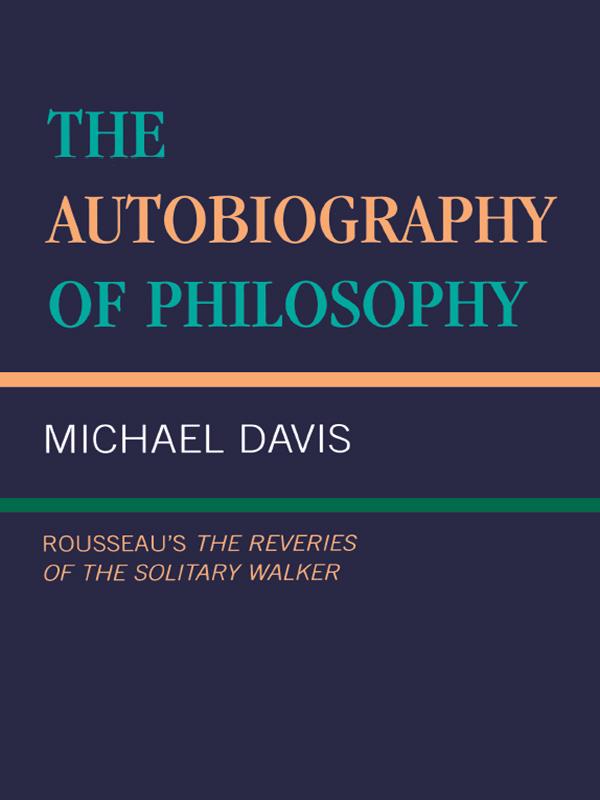
This is the most important book about the nature of philosophy and of the human soul published this year. In making the condition for its own possibility its deepest concern, philosophy is necessarily about itself-it is autobiographical. The first part of The Autobiography of Philosophy interprets Heidegger's Being and Time, Nietzsche's On the Genealogy of Morals, Aristotle's Metaphysics, and Plato's Lysis as examples of the implicitly autobiographical character of philosophy. The second part is a reading of Rousseau's The Reveries of the Solitary Walker. Although Rousseau's explicitly autobiographical writings are more often read for the tantalizing details of his rather eccentric life than for their philosophical import, this work is an artful use of Rousseau's exile and isolation-"the strangest position in which a mortal could ever find himself"-as a paradigm for the human soul in its relation to the world. In powerfully articulating the activity that is at the core of all philosophy, The Reveries articulates the nature of the human soul for which this activity is the defining possibility.
Pay easily by card, Klarna, Apple Pay or Google Pay. Not happy? You always have a 14-day money-back guarantee. Read more in our terms. If you have any questions, email us at hello@memmo.org.
Memmo makes studying easier – wherever you are in the world. We bring your course books and smart study tools together in one place: summaries, quizzes, podcasts and flashcards. Plus Ted, your study buddy who answers anything you wonder. Over 50,000 students already study here – built to help you learn faster and stress less.