
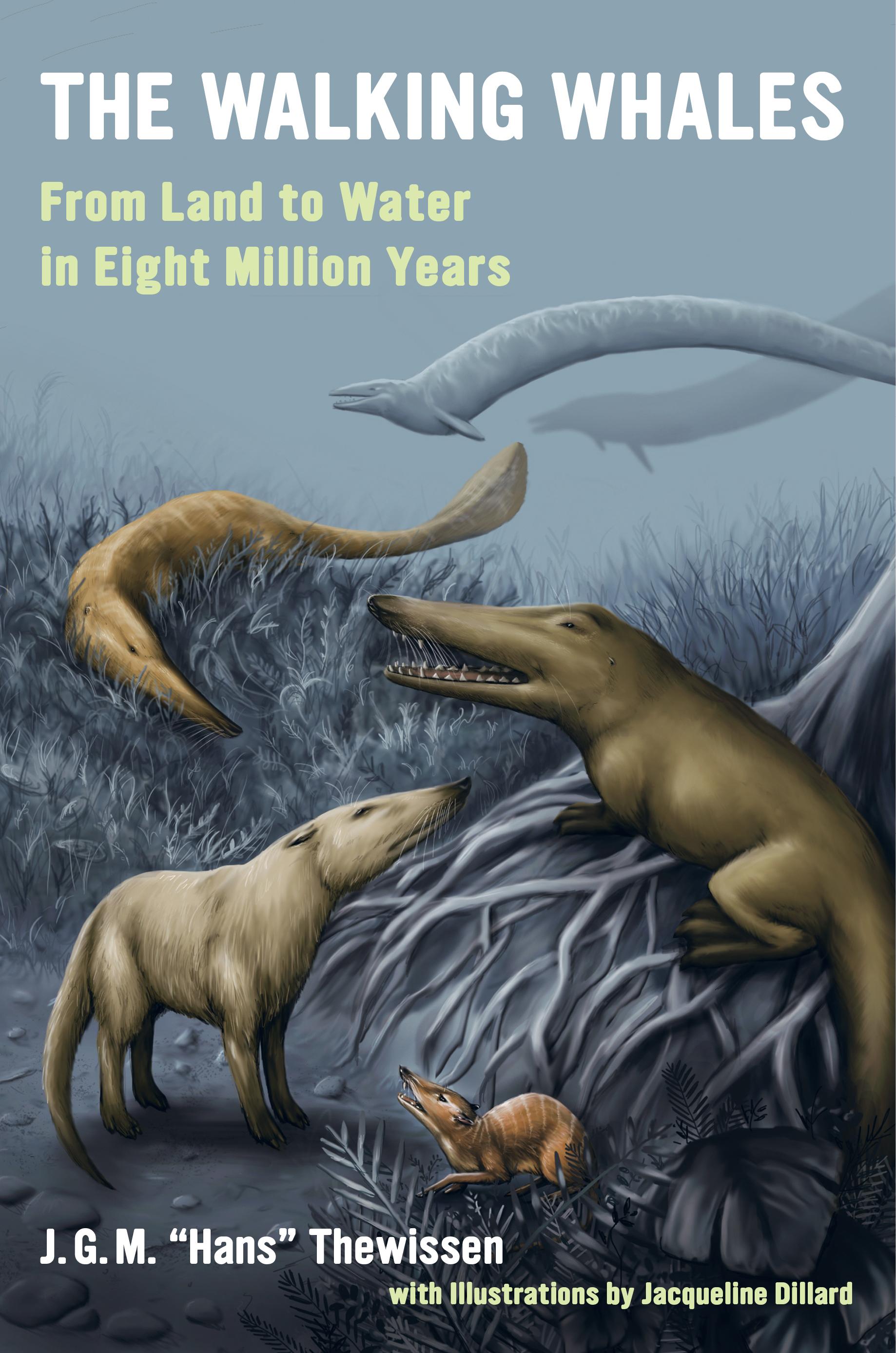
Hans Thewissen, a leading researcher in the field of whale paleontology and anatomy, gives a sweeping first-person account of the discoveries that brought to light the early fossil record of whales. As evidenced in the record, whales evolved from herbivorous forest-dwelling ancestors that resembled tiny deer to carnivorous monsters stalking lakes and rivers and to serpentlike denizens of the coast.
Thewissen reports on his discoveries in the wilds of India and Pakistan, weaving a narrative that reveals the day-to-day adventures of fossil collection, enriching it with local flavors from South Asian culture and society. The reader senses the excitement of the digs as well as the rigors faced by scientific researchers, for whom each new insight gives rise to even more questions, and for whom at times the logistics of just staying alive may trump all science.
In his search for an understanding of how modern whales live their lives, Thewissen also journeys to Japan and Alaska to study whales and wild dolphins. He finds answers to his questions about fossils by studying the anatomy of otters and porpoises and examining whale embryos under the microscope. In the book's final chapter, Thewissen argues for approaching whale evolution with the most powerful tools we have and for combining all the fields of science in pursuit of knowledge.
Thewissen reports on his discoveries in the wilds of India and Pakistan, weaving a narrative that reveals the day-to-day adventures of fossil collection, enriching it with local flavors from South Asian culture and society. The reader senses the excitement of the digs as well as the rigors faced by scientific researchers, for whom each new insight gives rise to even more questions, and for whom at times the logistics of just staying alive may trump all science.
In his search for an understanding of how modern whales live their lives, Thewissen also journeys to Japan and Alaska to study whales and wild dolphins. He finds answers to his questions about fossils by studying the anatomy of otters and porpoises and examining whale embryos under the microscope. In the book's final chapter, Thewissen argues for approaching whale evolution with the most powerful tools we have and for combining all the fields of science in pursuit of knowledge.
Pay easily by card, Klarna, Apple Pay or Google Pay. Not happy? You always have a 14-day money-back guarantee. Read more in our terms. If you have any questions, email us at hello@memmo.org.
Memmo makes studying easier – wherever you are in the world. We bring your course books and smart study tools together in one place: summaries, quizzes, podcasts and flashcards. Plus Ted, your study buddy who answers anything you wonder. Over 50,000 students already study here – built to help you learn faster and stress less.
You might also like
Buy the book0