
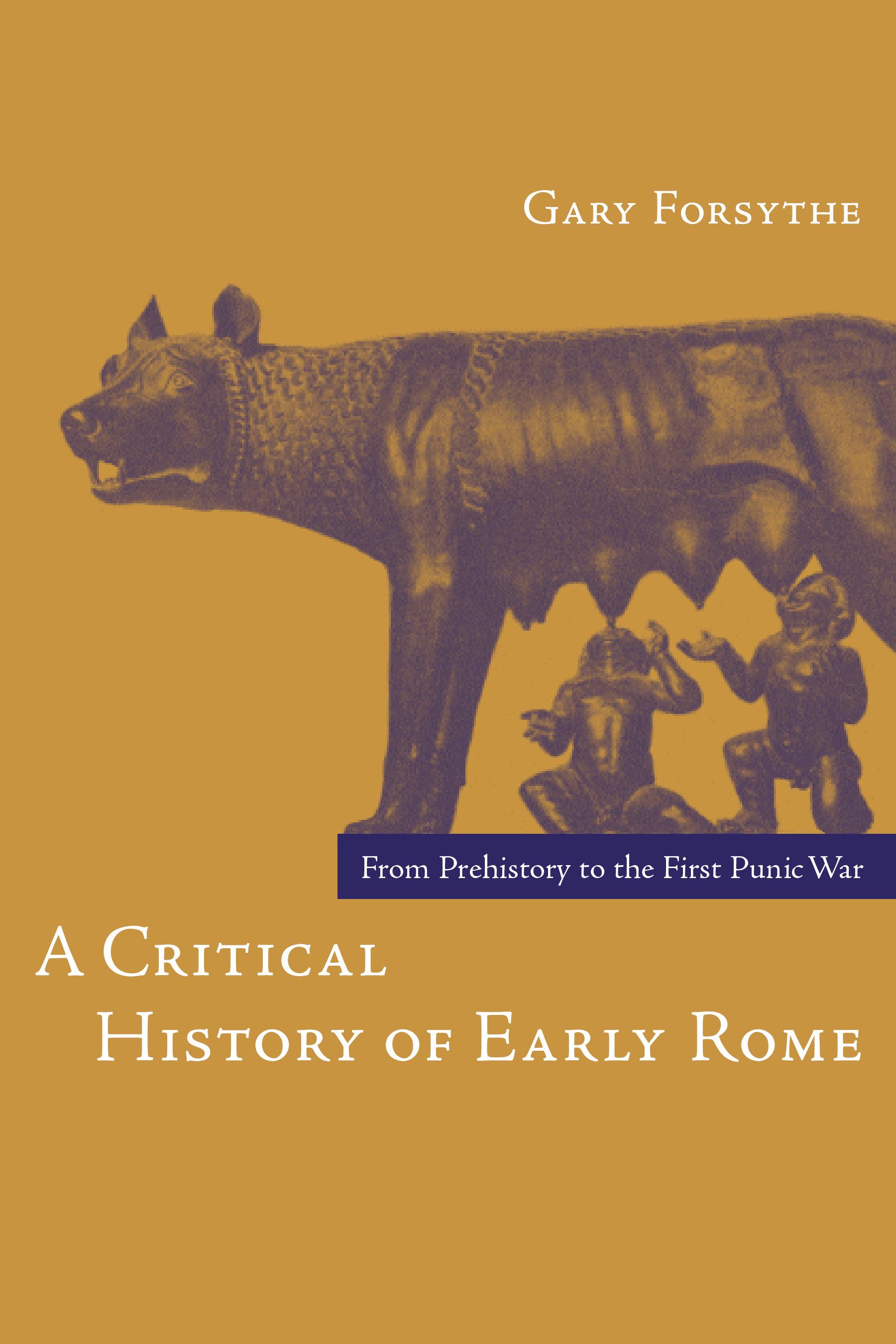
During the period from Rome's Stone Age beginnings on the Tiber River to its conquest of the Italian peninsula in 264 B.C., the Romans in large measure developed the social, political, and military structure that would be the foundation of their spectacular imperial success. In this comprehensive and clearly written account, Gary Forsythe draws extensively from historical, archaeological, linguistic, epigraphic, religious, and legal evidence as he traces Rome's early development within a multicultural environment of Latins, Sabines, Etruscans, Greeks, and Phoenicians. His study charts the development of the classical republican institutions that would eventually enable Rome to create its vast empire, and provides fascinating discussions of topics including Roman prehistory, religion, and language.
In addition to its value as an authoritative synthesis of current research, A Critical History of Early Rome offers a revisionist interpretation of Rome's early history through its innovative use of ancient sources. The history of this period is notoriously difficult to uncover because there are no extant written records, and because the later historiography that affords the only narrative accounts of Rome's early days is shaped by the issues, conflicts, and ways of thinking of its own time. This book provides a groundbreaking examination of those surviving ancient sources in light of their underlying biases, thereby reconstructing early Roman history upon a more solid evidentiary foundation.
In addition to its value as an authoritative synthesis of current research, A Critical History of Early Rome offers a revisionist interpretation of Rome's early history through its innovative use of ancient sources. The history of this period is notoriously difficult to uncover because there are no extant written records, and because the later historiography that affords the only narrative accounts of Rome's early days is shaped by the issues, conflicts, and ways of thinking of its own time. This book provides a groundbreaking examination of those surviving ancient sources in light of their underlying biases, thereby reconstructing early Roman history upon a more solid evidentiary foundation.
Pay easily by card, Klarna, Apple Pay or Google Pay. Not happy? You always have a 14-day money-back guarantee. Read more in our terms. If you have any questions, email us at hello@memmo.org.
Memmo makes studying easier – wherever you are in the world. We bring your course books and smart study tools together in one place: summaries, quizzes, podcasts and flashcards. Plus Ted, your study buddy who answers anything you wonder. Over 75,000 students already study here – built to help you learn faster and stress less.
You might also like
Buy the book0