
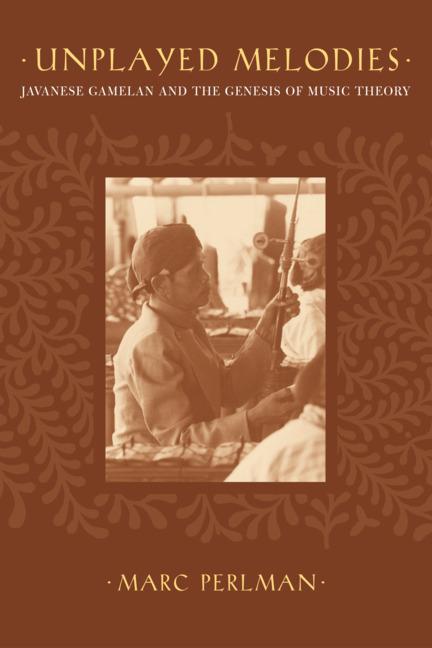
The gamelan music of Central Java is one of the world's great orchestral traditions. Its rich sonic texture is not based on Western-style harmony or counterpoint, but revolves around a single melody. The nature of that melody, however, is puzzling. In this book, Marc Perlman uses this puzzle as a key to both the art of the gamelan and the nature of musical knowledge in general.
Some Javanese musicians have suggested that the gamelan’s central melody is inaudible, an implicit or "inner" melody. Yet even musicians who agree on its existence may disagree about its shape. Drawing on the insights of Java’s most respected musicians, Perlman shows how irregularities in the relationships between the melodic parts have suggested the existence of "unplayed melodies." To clarify the differences between these implicit-melody concepts, Unplayed Melodies tells the stories behind their formulation, identifying each as the creative contribution of an individual musician in a postcolonial context (sometimes in response to Western ethnomusicological theories). But these stories also contain evidence of the general cognitive processes through which musicians find new ways to conceptualize their music. Perlman’s inquiry into these processes illuminates not only the gamelan’s polyphonic art, but also the very sources of creative thinking about music.
Some Javanese musicians have suggested that the gamelan’s central melody is inaudible, an implicit or "inner" melody. Yet even musicians who agree on its existence may disagree about its shape. Drawing on the insights of Java’s most respected musicians, Perlman shows how irregularities in the relationships between the melodic parts have suggested the existence of "unplayed melodies." To clarify the differences between these implicit-melody concepts, Unplayed Melodies tells the stories behind their formulation, identifying each as the creative contribution of an individual musician in a postcolonial context (sometimes in response to Western ethnomusicological theories). But these stories also contain evidence of the general cognitive processes through which musicians find new ways to conceptualize their music. Perlman’s inquiry into these processes illuminates not only the gamelan’s polyphonic art, but also the very sources of creative thinking about music.
Pay easily by card, Klarna, Apple Pay or Google Pay. Not happy? You always have a 14-day money-back guarantee. Read more in our terms. If you have any questions, email us at hello@memmo.org.
Memmo makes studying easier – wherever you are in the world. We bring your course books and smart study tools together in one place: summaries, quizzes, podcasts and flashcards. Plus Ted, your study buddy who answers anything you wonder. Over 50,000 students already study here – built to help you learn faster and stress less.
You might also like
Buy the book0