
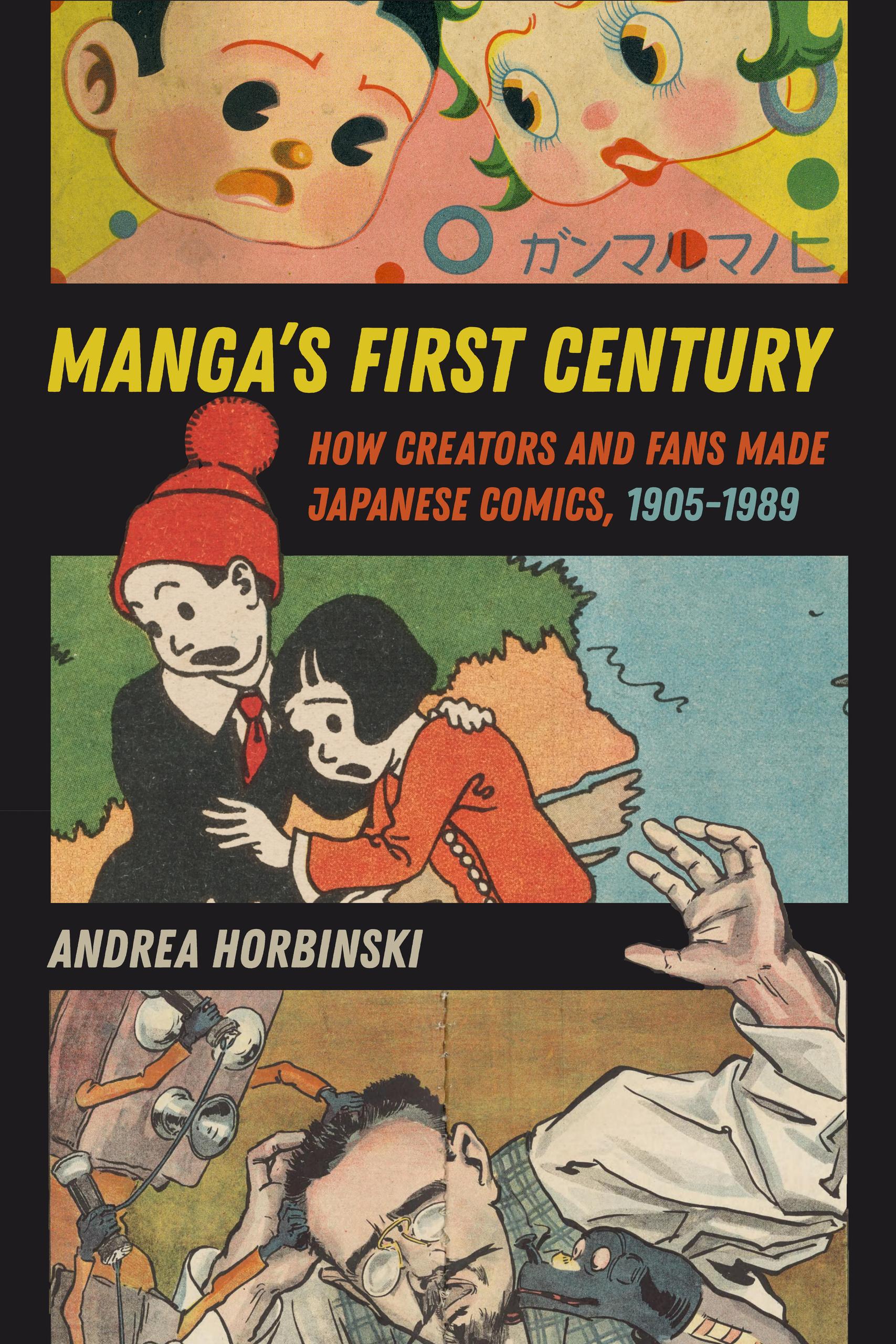
2026 Eisner Award Award Winner—Best Academic/Scholarly Work
A comprehensive English-language history of a beloved medium, Manga’s First Century tells the story of the artists and fans who built a cultural juggernaut.
Manga is the world’s most popular style of comics. How did manga and anime—"moving manga"—become ubiquitous? Manga’s First Century delves into the history and finds surprising answers.
In fact, manga has always been a global phenomenon. Countering essentialist myths of manga’s emergence from the deepest wells of Japanese art, author Andrea Horbinski shows it was born in the early 1900s, a hybrid form that crossed single-panel satirical cartoons popular in Europe and America with the Edo period’s artistic legacy. As a medium, manga initially focused on political commentary, expanding to include social satire, children’s comics, and proletarian art in the 1920s and 1930s. Manga’s evolution into a medium embracing complex, long-form storytelling was likewise driven by creators and fans pushing publishers to accept new, radical expansions in manga’s artistic and narrative practices. In the 1970s, innovative creators and fans empowered a new breed of fan-generated comics (dojinshi) and established robust audiences of adult, female, and queer manga readers, while nurturing generations of amateur and professional creators who continue to enrich and renew manga today.
Pay easily by card, Klarna, Apple Pay or Google Pay. Not happy? You always have a 14-day money-back guarantee. Read more in our terms. If you have any questions, email us at hello@memmo.org.
Memmo makes studying easier – wherever you are in the world. We bring your course books and smart study tools together in one place: summaries, quizzes, podcasts and flashcards. Plus Ted, your study buddy who answers anything you wonder. Over 50,000 students already study here – built to help you learn faster and stress less.