
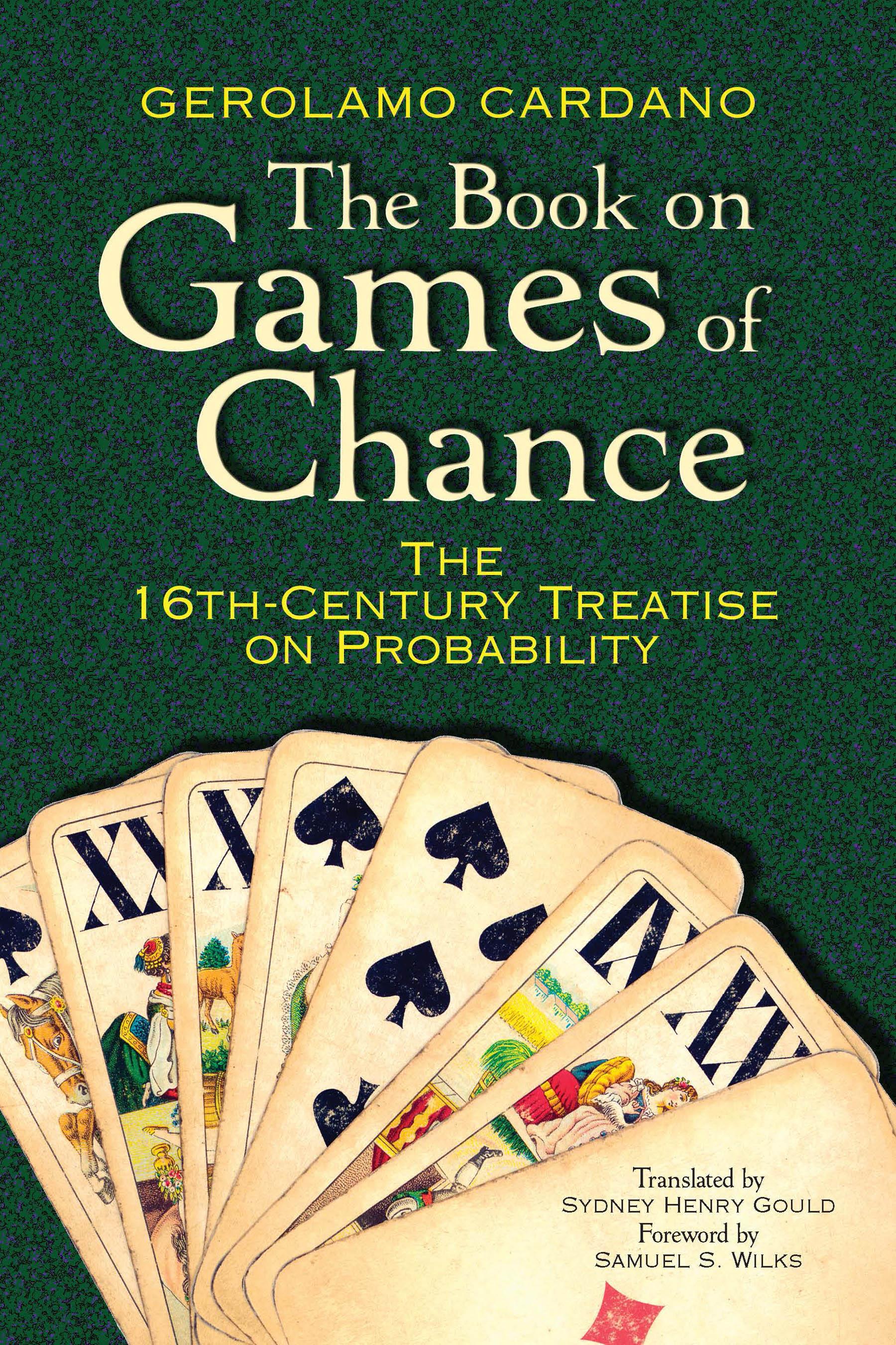
Mathematics was only one area of interest for Gerolamo Cardano ― the sixteenth-century astrologer, philosopher, and physician was also a prolific author and inveterate gambler. Gambling led Cardano to the study of probability, and he was the first writer to recognize that random events are governed by mathematical laws.
Published posthumously in 1663, Cardano's Liber de ludo aleae (Book on Games of Chance) is often considered the major starting point of the study of mathematical probability. The Italian scholar formulated some of the field's basic ideas more than a century before the better-known correspondence of Pascal and Fermat. Although his book had no direct influence on other early thinkers about probability, it remains an important antecedent to later expressions of the science's tenets.
Published posthumously in 1663, Cardano's Liber de ludo aleae (Book on Games of Chance) is often considered the major starting point of the study of mathematical probability. The Italian scholar formulated some of the field's basic ideas more than a century before the better-known correspondence of Pascal and Fermat. Although his book had no direct influence on other early thinkers about probability, it remains an important antecedent to later expressions of the science's tenets.
Pay easily by card, Klarna, Apple Pay or Google Pay. Not happy? You always have a 14-day money-back guarantee. Read more in our terms. If you have any questions, email us at hello@memmo.org.
Memmo makes studying easier – wherever you are in the world. We bring your course books and smart study tools together in one place: summaries, quizzes, podcasts and flashcards. Plus Ted, your study buddy who answers anything you wonder. Over 75,000 students already study here – built to help you learn faster and stress less.
You might also like
Buy the book0