
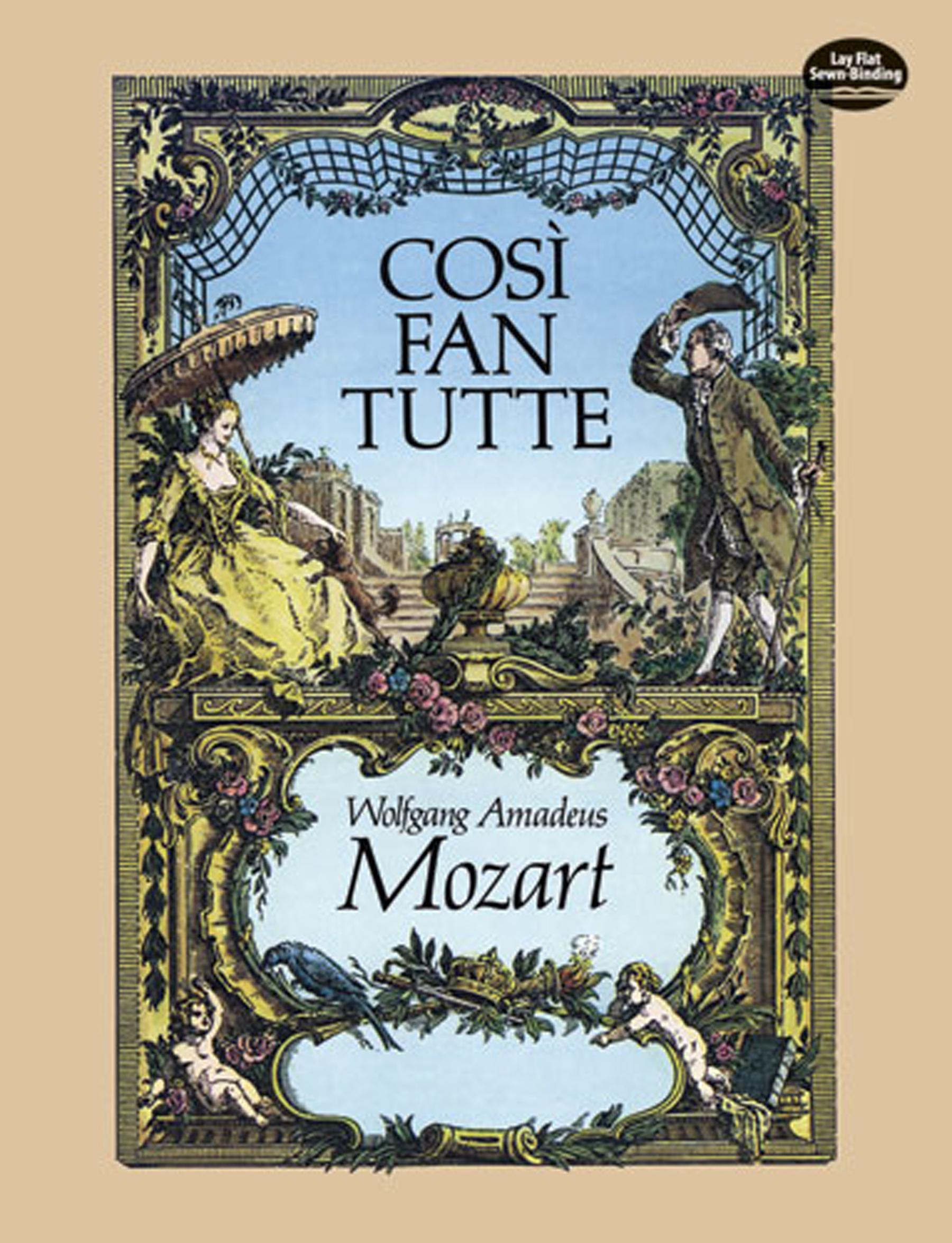
Translated from the Italian, Cosi fan tutte means "That's how all women act"; the libretto, the last of three Lorenzo da Ponte wrote for Mozart, concerns the behavior of women, particularly the behavior of young women in the throes of romantic love. Are they fickle? Are their affections mutable? Their virtue flexible? In Cosi fan tutte, Mozartand Da Ponte answer with resounding affirmatives.
In the nearly 200 years since it was first performed at the Burgtheater in Vienna, Cosi fan tutte has waxed and waned and waxed again in popularity. The music, with its richness of melody, harmony, and texture, and its perfection of form, has never been considered less than brilliant. The libretto, however, has not been as well received as evidenced by attempts in the 19th century to "improve" it, making it more possible to the overly decorous sensibilities of the Victorians.
In examining the reaction of 19th-century opera goers, the noted British composer, conductor, and musicologist Spike Hughes laments, "The opera must indeed have seemed to them sadly untypical of the Divine Mozart, who not only seemed to enjoy this trivialities, not to say indecencies, of an exquisitely constructed libretto, but even went so far as to squander an unending stream of lovely music on worthless characters and contemptible situations."
The "worthless" characters are Ferrando and Guglielmo, two Italian army officers in love with two Neapolitan sisters, Fiodiligi and Dorabella. The "contemptible" situation is a wager and the comedy of deception that ensues: bragging of their ladies' fidelity, the two officers are challenged by a sage but cynical Don Alfonso who declares, "The faithfulness of woman is like the phoenix: everybody has heard about it, but nobody has ever actually seen it."
In the 20th century Cosi fan tutte has once again secured its rightful and prestigious place among the world's great operas. This volume, containing the full score with Italian and German text, is reproduced from one of the most complete, accurate, and scholarly editions available. It also contains a new translation of the German editors' frontmatter and critical commentary, which includes a review of dubious passages and text problems. Beautifully and clearly engraved, this modestly priced edition of Cosi fan tutte will be welcomed by musicians, students, and all opera lovers.
Pay easily by card, Klarna, Apple Pay or Google Pay. Not happy? You always have a 14-day money-back guarantee. Read more in our terms. If you have any questions, email us at hello@memmo.org.
Memmo makes studying easier – wherever you are in the world. We bring your course books and smart study tools together in one place: summaries, quizzes, podcasts and flashcards. Plus Ted, your study buddy who answers anything you wonder. Over 50,000 students already study here – built to help you learn faster and stress less.